PD44-06: Chemotherapy vs immunotherapy as neoadjuvant therapies in cisplatin-eligible patients undergoing radical cystectomy for muscle invasive bladder cancer
IRCCS Ospedale San Raffaele / Università Vita-Salute San Raffaele
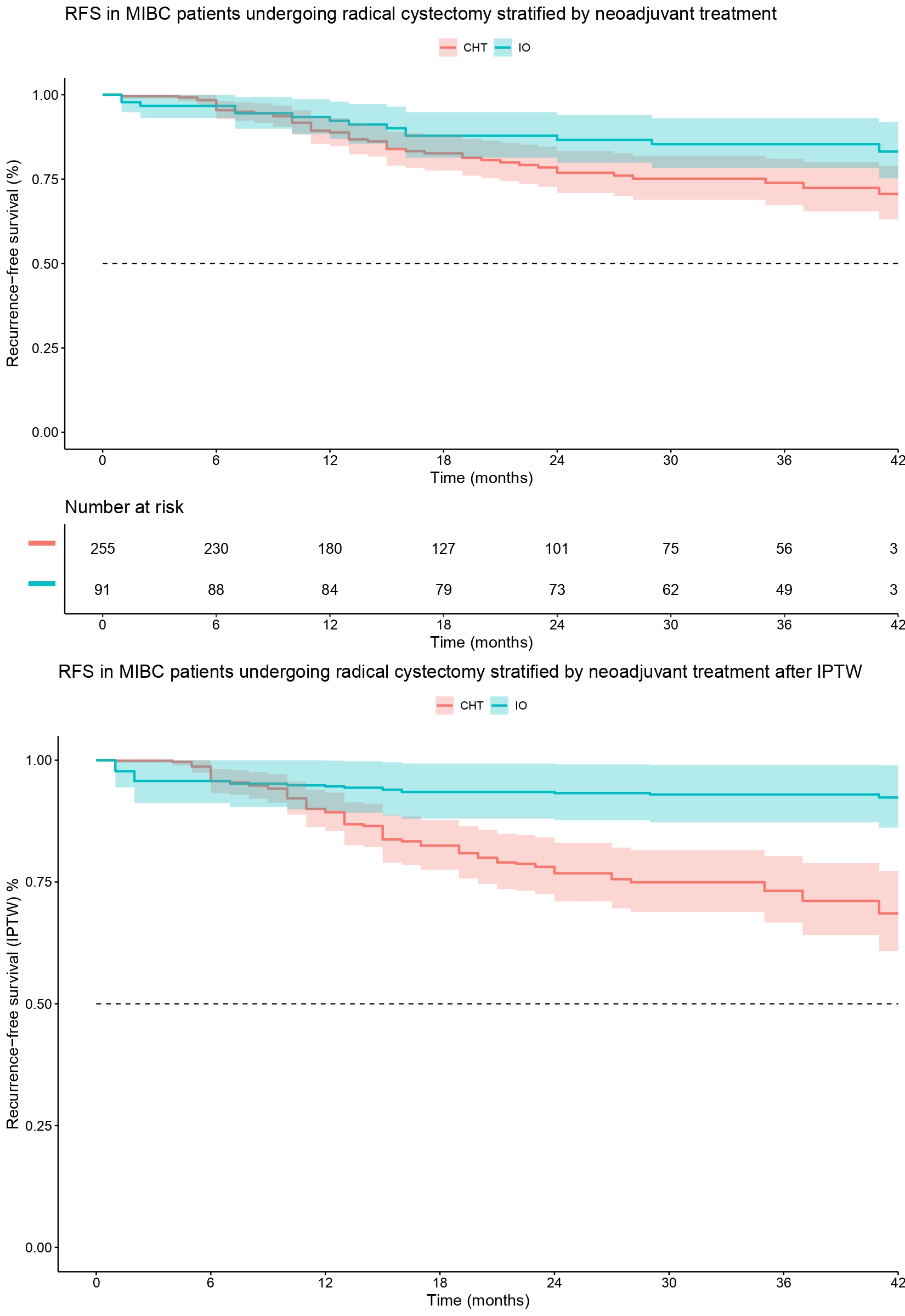
Introduction: Chemotherapy has represented one of the cornerstone of the treatment landscape of muscle invasive bladder cancer (MIBC), due to its improvement in survival outcomes. Recently, also immunotherapy also showed to improve both pathological response, as well as survival outcomes. However, no comparison has ever been performed between the two neoadjuvant treatments. We aimed to compare cisplatinum-based chemotherapy and pembrolizumab in MIBC patients undergoing radical cystectomy (RC). Methods: We retrospectively identified patients with MIBC and treated with RC after neoadjuvant treatment with either cisplatin or pembrolizumab in two tertiary referral centers. Cisplatinum-eligibility represented an inclusion criterion. Conversely, clinical node positive disease and adjuvant chemotherapy administration were exclusion criteria. The endpoint of the analyses was recurrence-free survival (RFS). Statistical analyses consisted of Kaplan-Meier (KM) curves before and after inverse-probability treatment weighting (IPTW), adjusting for age, gender, pathological stage, concomitant CIS and variant histology (VH). Results: Of all 346 patients, median age was 67 years (IQR 60-73) and the majority of patients were male (80.3%). The majority of patients harbored a pT0N0 disease (30.3%) at RC pathology followed by pT2-4N0 (29.5%), pTanyN1-3 (20.5%) and pT1-a-isN0 (19.6%). Moreover, 113 patients (32.6%) exhibited concomitants CIS, while 255 patients (73.7%), 27 patients (7.8%) and 64 patients (18.5%) showed respectively presence of pure/mixed urothelial carcinoma, pure VH and other histology. Overall, 70 patients (20.2%) experienced recurrence (33.9% pelvic vs 66.1% distant) after a median follow-up of 24 months (12-39). KM showed a 24-months RFS of 76.9 vs 86.6% for cisplatinum-based chemotherapy versus pembrolizumab (p < 0.01). After IPTW for age, gender, pathological stage, concomitant CIS and VH, KM showed 76.8 vs 93.2% for cisplatinum-based chemotherapy versus pembrolizumab (p=0.01). Conclusions: We compared RFS after cisplatinum chemotherapy vs pembrolizumab as neoadjuvant treatment in MIBC undergoing RC. Our findings suggest a potentially higher benefit of pembrolizumab, that was confirmed after adjustment for confounders. SOURCE OF Funding: NONE