IRCCS Ospedale San Raffaele / Università Vita-Salute San Raffaele
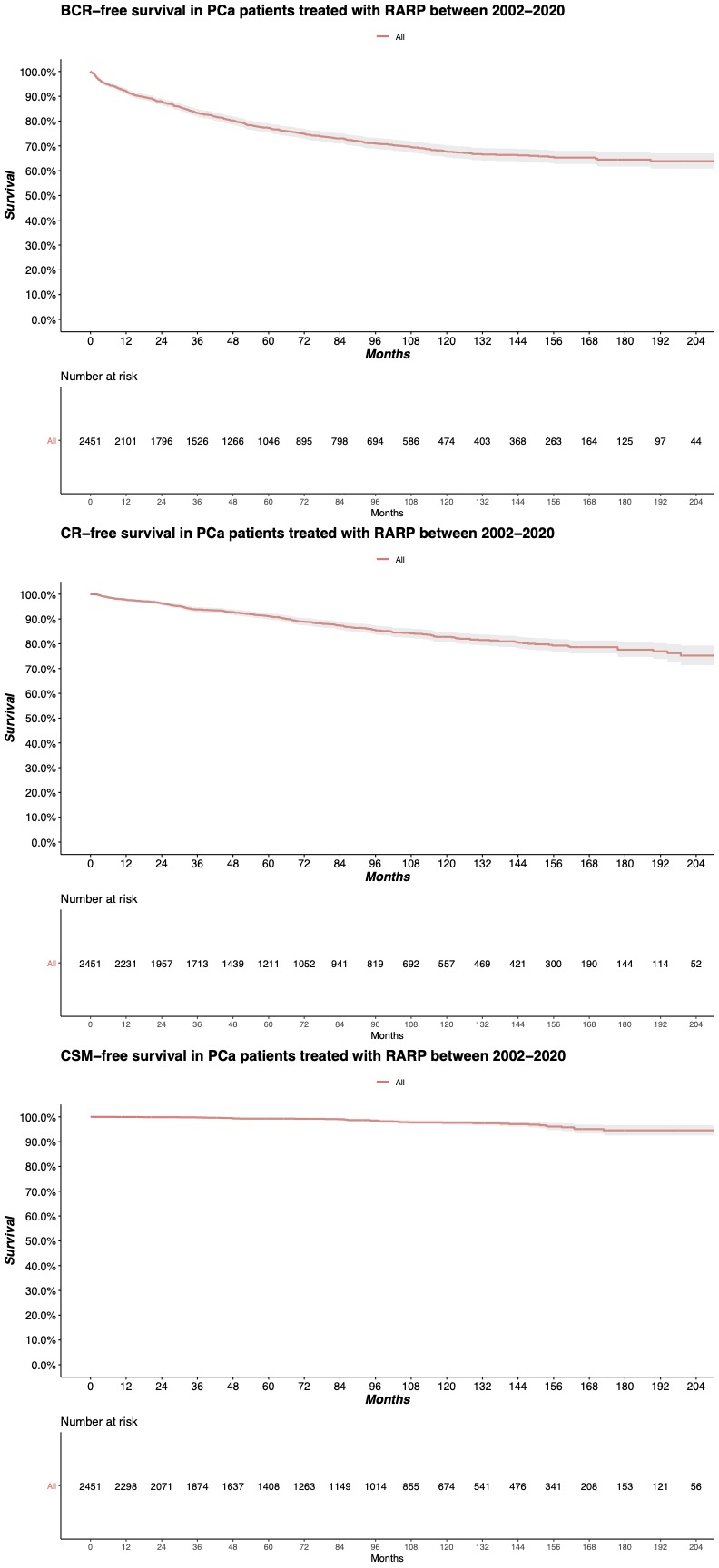
Introduction: Since its introduction in the treatment landscape of prostate cancer (PCa), robot-assisted radical prostatectomy (RARP) exhibited excellent short- and mid-term oncological outcomes. However, long-term oncological outcomes are still underreported. Here, we examined oncological outcomes of a single-center RARP cohort with the longest follow-up Methods: We retrospectively identified 2,451 PCa patients treated with RARP at a high-volume tertiary referral center between 2002 and 2020. Kaplan-Meier (KM) analyses examined biochemical recurrence (BCR), clinical recurrence (CR) and cancer-specific mortality (CSM) rates. Uni- and multi-variable Cox regression models assessed independent predictors of BCR, CR and CSM after stratification for age, year of surgery (YOS) and PSA level Results: Median (interquartile range [IQR]) age and preoperative PSA were 64 (59, 69) years and 7.3 (5.3, 10.6) ng/ml. Most patients harbored a cT1c disease (45%), followed by cT2a, cT2c, cT3, cT2b and cT1a-b, accounting for 21%, 17%, 10%, 5% and 2%, respectively. The vast majority of patients had biopsy ISUP group 1-2 (78%), followed by ISUP group 3 and 4-5 in 12% and 11%. On final pathology, most patients harbored pT2 disease (66%), followed by pT3a (20%), pT3b (6%) and pT4 ( <1%) disease, whereas ISUP group 1-2 was the most frequent grade (69%), followed by ISUP group 3 and 4-5 in 21% and 11% of patients. pN1 disease was found in 7% of patients. A total of 425 (17%) patients had PSM. During follow-up, 584 patients experienced BCR, 286 CR and 41 CSM. The 15-year BCR-, CR- and CSM-free survival was 64% (95% confidence interval [CI]: 62%, 67%), 78% (95%CI: 75%, 81%) and 95% (95%CI: 92%, 97%) respectively (Figure 1). The 18-year BCR-, CR- and CSM-free survival was 64% (95%CI: 61%, 67%), 75% (95%CI: 71%, 79%) and 95% (95%CI: 92%, 97%) respectively. On multivariable Cox regression model, pathological stage, pathological ISUP grade group and PSM represented all independent predictors of BCR, CR and CSM (all p<0.01) Conclusions: Our study – with the longest follow-up in a series of RARPs – showed excellent oncological outcomes after surgery in individuals with favorable PCa characteristics, also after 18 years of follow-up. Further, multi-center validations are awaited to confirm these findings SOURCE OF Funding: None