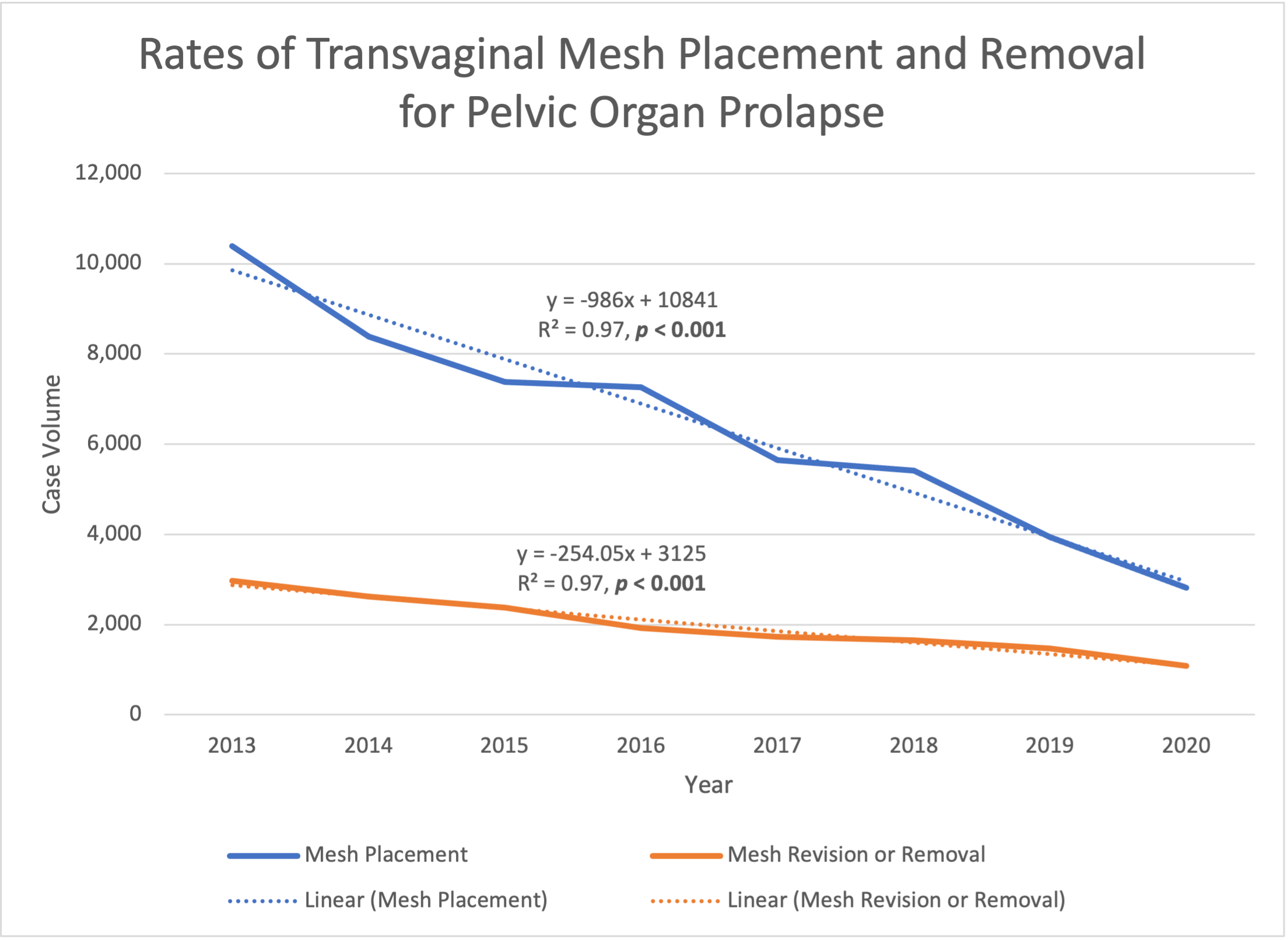
Introduction: In April 2019, the Food and Drug Administration (FDA) banned manufacturers from selling and distributing mesh for transvaginal repair of pelvic organ prolapse (POP). We assessed national incidences of transvaginal mesh placement and revision or removal for POP before and after the ban. Methods: The Medicare Physician and Other Practitioners database was queried for all transvaginal mesh placements and revisions or removals for POP between 2013 and 2020 using CPT codes 57267 and 57295, respectively. Linear regression was performed with statistical significance set to 95% confidence intervals. Results: A total of 51,234 mesh placements and 15,854 mesh revisions or removals were identified. As shown in the figure, there was a significant and gradual downward trend in utilization of both procedures during the study period, without precipitous changes after the ban (mesh placement, R² = 0.97, p < 0.001; mesh revisions or removals, R² = 0.97, p < 0.001). From 2013 to 2020, mesh placement decreased from 10,397 to 2,813 cases (370%) and mesh revision or removal decreased from 2,975 to 1,091 cases (270%). Despite the FDA ban, transvaginal mesh placement for POP was still performed in 2020 (2,813 cases). Conclusions: There was not a precipitous decline in the use of transvaginal mesh for prolapse after the 2019 ban. Utilization has instead gradually decreased since the original FDA notification in 2011. Physicians may now be using the remaining stock of transvaginal mesh or other types of mesh that are off-label for prolapse repair. It is important to discuss the risks and benefits of using transvaginal mesh as well as the FDA notification and ban with patients prior to prolapse surgery. SOURCE OF Funding: None.