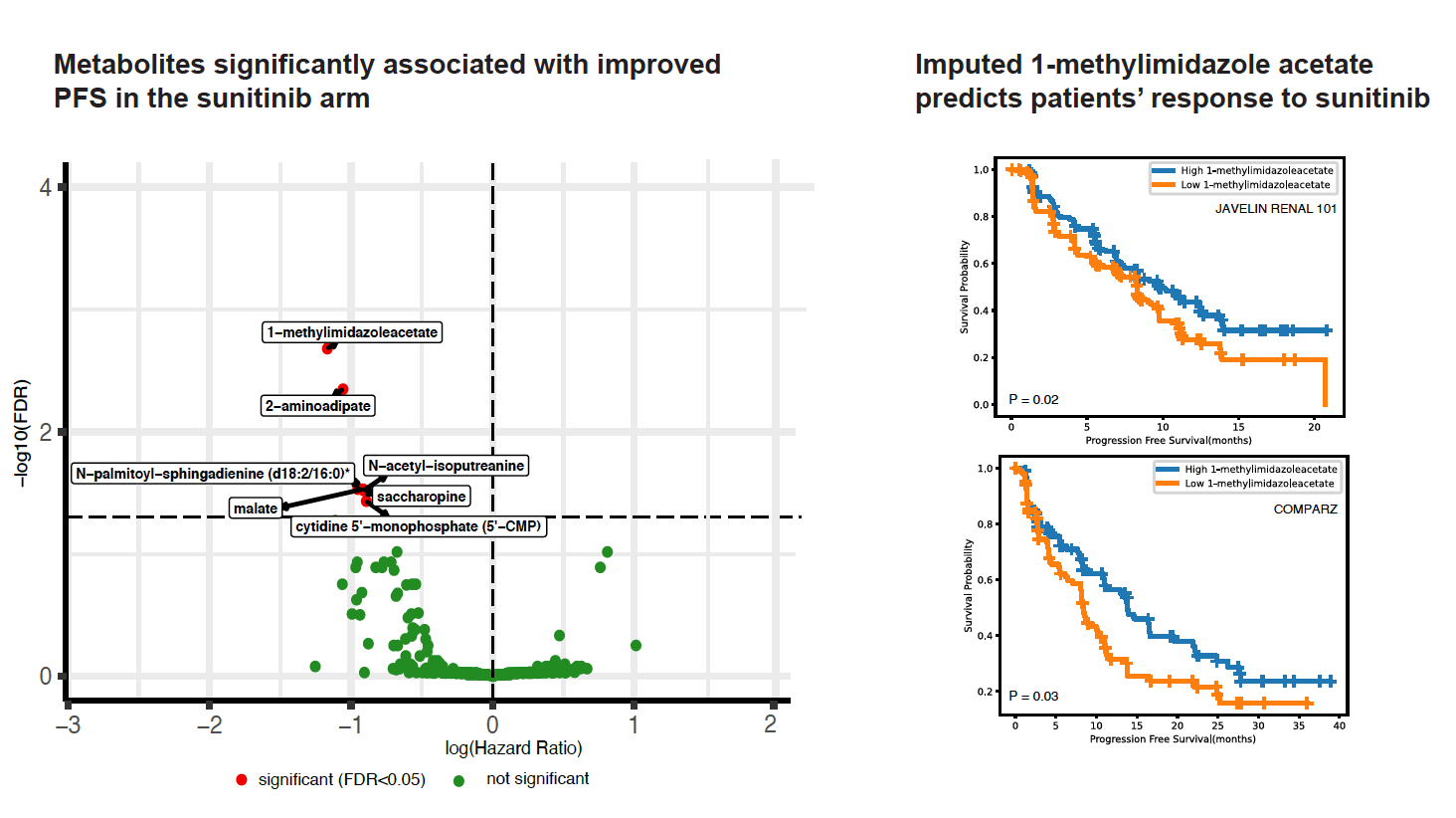
Introduction: Clear cell renal cell carcinoma (ccRCC) is a metabolic disease with multiple mutated genes involved in the regulation of cellular metabolic processes, however it remains unknown how ccRCC metabolites are associated with response to anti-VEGF or immunotherapy agents. Metabolomic signatures may serve as a biomarker of response or serve as future points of intervention for targeted agents. Thus, we sought to characterize metabolite signatures associated with response to anti-VEGF therapy in patients with ccRCC. Methods: A machine learning algorithm called T-MIRTH (Transcriptomics-Metabolite Imputation via Rank-Transformation and Harmonization) was developed to identify key metabolites. In short, this algorithm imputes metabolite abundances from RNA sequencing data by modeling metabolite-RNA covariation across datasets with paired metabolomics and transcriptomics data. 262 well-predicted metabolites were used to test the association between imputed levels of individual metabolites by T-MIRTH and progression free survival (PFS) in 7 published sunitinib clinical trials in advanced ccRCC. Using a multivariable Cox proportional hazard model, metabolomic signatures were correlated with progression-free survival and regression results were aggregated using a random effects meta-analysis model. Results: Our T-MIRTH algorithm was validated using 3 ccRCC datasets with paired metabolomics and transcriptomics data and we demonstrated that T-MIRTH can accurately predict metabolite levels using RNA sequencing data. We then demonstrated using the ccRCC TCGA that T-MIRTH predicted metabolic differences between both tumor/normal samples and high/low-stage samples. Our algorithm was able to identify 262 validated metabolites. The results from our meta-analysis across 7 clinical trial demonstrated 7 metabolites significantly associated with improved PFS in the sunitinib arm (FDR < 0.05). In particular, high levels of 1-methylimidazole acetate had improved PFS within the sunitinib arm across all trials. Conclusions: Using a novel algorithm, we identified 7 metabolites that were associated with improved PFS in patients treated with sunitinib across 7 clinical trials. These metabolites may serve as biomarkers of response and may also be important targets for future therapeutics. SOURCE OF Funding: N/A