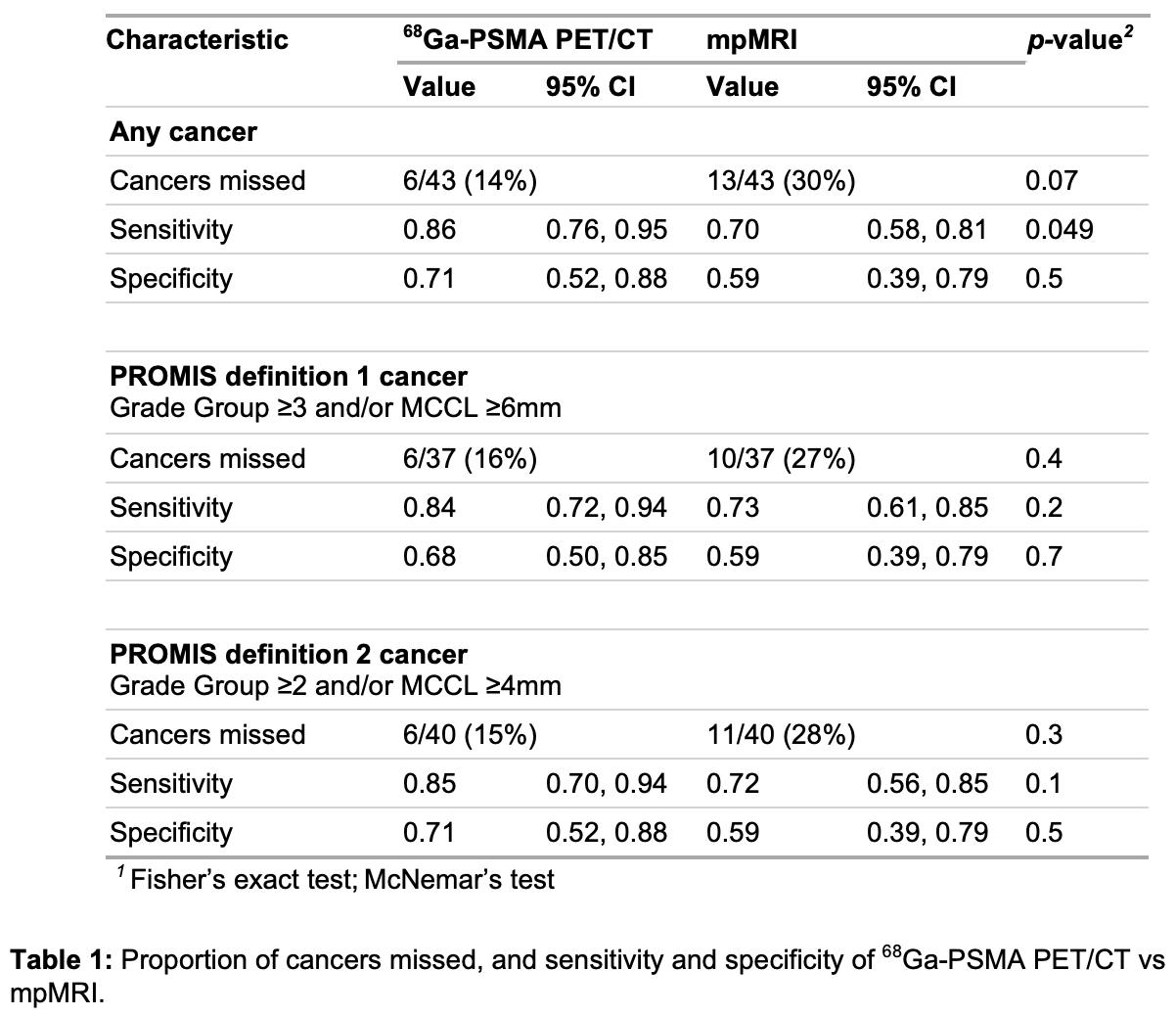
Introduction: Local salvage therapy for men with localized radiorecurrent prostate cancer requires accurate diagnosis of intra-prostatic lesions. PSMA PET/CT is increasingly used for whole-body restaging, but its ability to localize intra-prostatic lesions is unclear. Using a histopathological reference, we compared the diagnostic accuracy of 68Ga-PSMA PET/CT to multiparametric MRI (mpMRI) for identifying intra-prostatic radiorecurrent cancer. Methods: This is a single-center retrospective series (2017-2022) of men with a rising prostate-specific antigen post-radiotherapy, who underwent both index tests (68Ga-PSMA PET/CT and mpMRI) and a systematic and/or targeted biopsy (reference test). PET/CTs were analyzed in sextants by a single, blinded expert reader using a 5-point Likert score, with scores =3 indicating a suspicious scan. mpMRIs were designated suspicious or non-suspicious. Sensitivity and specificity of PET/CT vs mpMRI were compared using McNemar’s test. 3 cancer definitions were studied: any cancer; Grade Group =3 and/or maximum cancer core length (MCCL) =6mm (PROMIS definition 1); and Grade Group =2 and/or MCCL =4mm (PROMIS definition 2). Analyses were performed at the hemi-gland level using cluster bootstrapping with 10,000 resamples. Results: Of 70 eligible hemi-glands (35 men), 43 (61%) had any cancer on biopsy. PET/CT missed 6 cancers (14%) and mpMRI missed 13 (30%; p=0.07). 10 mpMRI-undetected cancers were detected by PET/CT. PET/CT had significantly higher sensitivity (0.86, 95%CI 0.76-0.95) versus mpMRI (0.70, 95%CI 0.58-0.81; p=0.049). However, specificity was not significantly different (PET/CT 0.71, mpMRI 0.59; p=0.5) (Table 1). For PROMIS definitions 1 and 2, PET/CT missed 6/37 (16%) and 6/40 (15%) cancers, respectively. mpMRI missed 10/37 (27%) definition 1 and 11/40 (28%) definition 2 cancers, of which 7 and 8 were detected by PET/CT, respectively. For both definitions, sensitivity and specificity did not significantly differ (Table 1). Conclusions: 68Ga-PSMA PET/CT had good sensitivity that improved upon mpMRI for identifying intra-prostatic radiorecurrent cancer of any grade or length. Furthermore, most mpMRI-undetected cancers were detected by PET/CT. Using both together may optimize diagnosis of intra-prostatic disease. SOURCE OF Funding: Nil