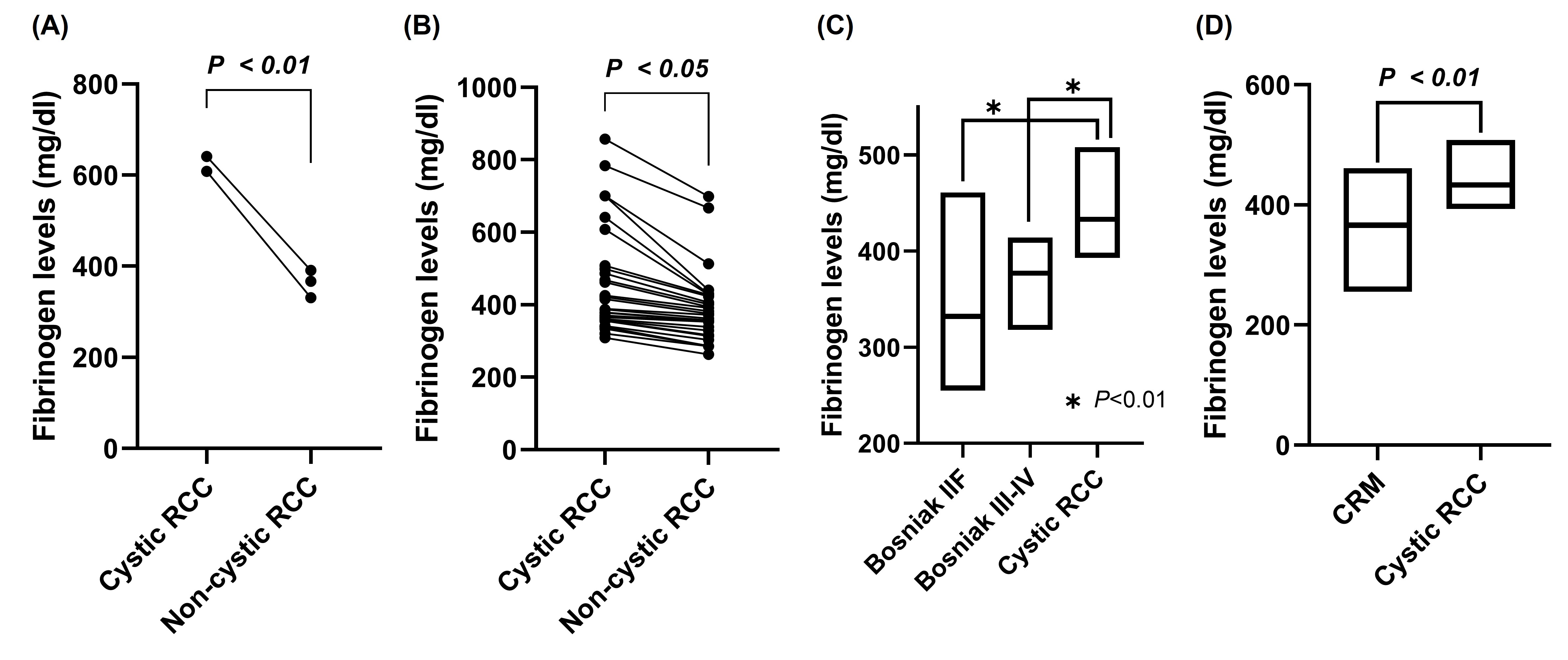
Introduction: About 15% of renal cell carcinomas (RCCs) have a cystic component and a distinct subset of RCC, described as “cystic RCC”, accounts for 5% of all RCCs and has a favorable prognosis to other types of RCC. RCC, appeared as a cystic renal mass (CRM) on computed tomography (CT), should be differentiated from benign renal cysts. Due to the advancement of diagnostic imaging techniques and increased use of use of cross-sectional imaging, detection of small renal masses increased. Here, we demonstrated the genomic profiling of cystic T1a RCC in comparison with non-cystic T1a RCC and evaluated the usefulness of the biomarker for predicting the risk of malignancy in complex CRM of =4 cm. Methods: Using a prospective cohort (ClinicalTrials.gov Identifier: NCT03694912) RCC database, 2 cases of cystic T1a RCC and 3 cases of non-cystic T1a RCC were selected, and RNA sequencing was performed. Plasma fibrinogen levels were retrospectively reviewed. Patients diagnosed as complex CRM of =4 cm that categorized as Bosniak categories IIF, III, and IV between 2019 to 2021 were included. The pathological results were compared with preoperative plasma fibrinogen levels. Results: Totally, 520 genes were differentially expressed with fold changes and p-values <0.05, and 3 genes (fibrinogen alpha chain (FGA) gene, fibrinogen beta chain (FGB) gene, and fibrinogen gamma chain (FGG) gene) were identified with the greatest upregulation in cystic T1a RCC even after the adjustment. Plasma fibrinogen levels of cystic T1a RCC was 624.5 mg/dl, which was significantly higher than non-cystic T1a RCC with 363.0 mg/dl (P < 0.01) (Figure 1A). In validation group (58 patients), significantly higher plasma fibrinogen levels of cystic T1a RCC compared to non-cystic T1a ccRCC were confirmed (P < 0.05, Figure 1B). For complex CRM group, 29 patients were included and 22 patients underwent surgeries with malignancy rate as follows: Bosniak category IIF, 0/6 (0%); category III, 7/12 (58.3%); category IV, 4/4 (100%). Plasma fibrinogen level of those diagnosed as cystic RCC was 445.7 mg/dl, which was significantly higher than that of category IIF cysts and/or category III-IV cysts (P <0.01, Figure 1C and 1D). Conclusions: This study is the first to demonstrate and suggest the role of plasma fibrinogens to differentiate between benign complex CRM from cystic RCC of =4 cm. SOURCE OF Funding: This work was supported by a grant from the Korea Health Technology R&D Project through the Korea Health Industry Development Institute funded by the Ministry of Health & Welfare, Republic of Korea [grant number: HI17C1095], and the National Research Foundation of Korea (NRF) grant funded by the Korean government (MSIT) [grant number: 2019R1A2C1002863 and 2022R1A2C2003831].