Undergraduate Pre-Dental Student UCLA, California, United States
Abstract:
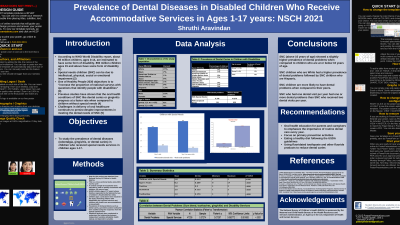
Objectives: To study the prevalence of dental diseases (odontalgia, gingivitis, or dental caries) in children who received special needs services in children ages 0-17.
Methods: This cross-sectional study involves 50,892 children (ages 0-17 years) whose families responded to the National Survey of Children’s Health (NSCH) in 2021. Children who received special services (CSS) were about 8,304 (16%). Demographic factors such as age, gender, and race/ethnicity may influence the development of dental diseases. Univariate and bivariate analyses were conducted to understand the prevalence of dental diseases in children who received special needs services.
Results: 65% of the children who were CSS were males. The mean age of the CSS was nine years, and most responders were English-speaking families (94%). Hispanic respondents were at 13%, and 76% of the non-Hispanics were Whites. Although most of the CSS had routine dental visits, 71% of the responders had one or more dental problems (odontalgia, gingivitis, or dental caries).
Conclusion: Children who receive special needs services face significant difficulties in maintaining oral hygiene. A multi-faceted approach to care involving medical and dental professionals is required to address the dental needs of this population. Parents and caretakers must be educated on the significance of routine dental care.