Clinical Assistant Professor Texas A&M College of Dentistry, Texas, United States
Abstract:
Introduction: Misinterpretation of forensic dental evidence runs the risk of failure to identify individuals and potentially even wrongful convictions. Therefore establishing the validity of forensic odontology methods through the research that supports it carries extreme significance.
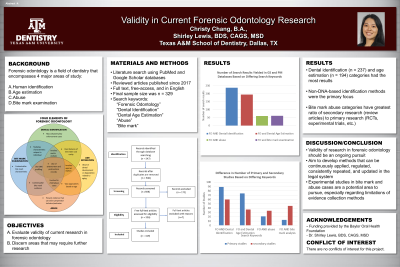
Objective: To evaluate the validity of current forensic odontology research on dental identification, age estimation, abuse cases, and bitemark analysis.
Methods: Searches were conducted on PubMed and Google Scholar databases and limited to free-access articles published since 2017. Due to the high volume of Google Scholar articles, only the first 50 search results were screened. Search keyword combinations included “forensic odontology”, “dental identification”, “abuse”, “dental age estimation”, and “bite mark”. The search was conducted over 8 weeks as part of a summer research program for students entering dental school.
Results: Of all the research articles screened, primary studies slightly outnumbered secondary studies. Dental age estimation had the highest proportion of primary studies to secondary studies, while bite mark analysis yielded the smallest primary to secondary study ratio. Articles on dental age estimation tends to be cited by other articles most frequently, while bite mark analysis had the least citations. The median sample size for primary studies on bite mark analysis was also consistently the least.
Conclusions: The validity of research in forensic odontology is required to legitimize the methods potentially used in the legal system. Thus, it is essential to routinely evaluate forensic research to ensure justice will be upheld and victims of disaster and crime can get the closure they deserve.