Postdoctoral Fellow CSC at NYU Langone Medical Center New York, New York, United States
1.
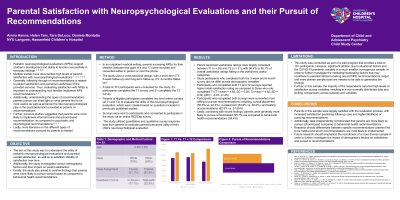
Objective: Parent’s overall satisfaction with neuropsychological evaluations has been consistently linked with implementation of recommendations and follow-up care. The aim of this study was to establish stability of satisfaction over time, as well as to confirm findings that parents were more likely to pursue school-based as compared to behavioral health recommendations. 2.
Method: Study participants (ages 4-17, 63% white, 83% non-Hispanic) were recruited from an outpatient clinic, shortly after completing a neuropsychological evaluation. Parent satisfaction data were collected at 3-weeks (T1 n=49) and 6-months (T2 n=30) following evaluation completion. 3.
Results: Parent perceived usefulness ratings were largely consistent between T1 and T2, with 96.4% to 98.1% of overall usefulness ratings falling in the useful/very useful categories. Study participants who completed both the 3-week and 6-month surveys did not differ across demographic variables. Participants who completed both T1 and T2 surveys reported higher initial satisfaction ratings as compared to those who only completed T1 (T1 mean=4.92, SD=0.28, T2 mean=4.83, SD=0.39; t(46)=-0.97, p=05). Additionally, participants who completed both surveys were somewhat more willing to pursue recommendations including, school placement (55.6% vs. 44.4%), in-classroom (53.8% vs. 46.2%), and testing accommodations (62.5% vs. 37.55). Consistent with recent findings, parents were generally more likely to pursue school-based (95.7%) as compared to behavioral health recommendations (84.4%). 4. Conclusion(s): Parents in this sample were largely satisfied with the evaluation process, with increased satisfaction predicting follow-up care and a higher likelihood of pursuing recommendations. Additionally, data independently corroborated that parents are more likely to pursue school-based compared to behavioral health recommendations.