Ph.D. Student in Clinical Psychology Long Island University Brooklyn Brooklyn, New York, United States
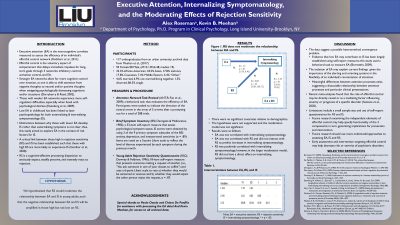
Objective: Executive attention (EA), the neurocognitive correlate of effortful control (EC), allows attention to shift between negative, neutral, and positive thoughts. Links between EA and externalizing symptomatology have been established, but explanation as to why individuals develop internalizing symptomatology (IS) is limited. Research supports that those high in rejection sensitivity (RS) are more likely to develop IS; however, this relationship has not been investigated while also measuring levels of EA. We hypothesized that RS would moderate the relationship between EA and IS in adults, such that the negative relationship between EA and IS will be amplified in those high but not low on RS.
Method: 117 undergraduate students, (M = 21.39 years, SD = 6.38), a non-clinical sample of convenience from a 2017 study, completed the Attention Network Task, the Brief Symptom Inventory, and the Rejection Sensitivity Questionnaire. The sample was 76.5% female; 33.3% African-American, 18.5% Asian, 17.8% Latino/a, 17.8% White, 7.4% Middle Eastern, and 4.4% “Other.”
Results: There was no significant positive effect of EA on IS, B = .55 95% CI [-5.30, 6.40], p = .85. RS was positively correlated (r = .18, p = .02) with IS, supporting previous research. EA was not correlated with RS and did not interact with RS to predict increases in IS, B = -3.30 95% CI [-30.41, 23.83], p =.81.
Conclusion: Results suggest a heteromethod convergence problem and/or the role of other attention processes within EC, suggesting dissociable relationships between attention processes and clinical presentations. Limitations include sample size, composition, and use of self- report measures.