Neuropsychologist and Assistant Professor of Clinical Neurology Vanderbilt University Medical Center Nashville, Tennessee, United States
Objective: LATE is a common but underrecognized neuropathology that causes a progressive amnestic syndrome in older adults which mimics an Alzheimer’s disease (AD) clinical profile.
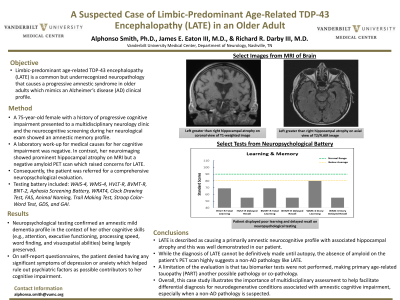
Method: A 75-year-old female with a history of progressive cognitive impairment presented to a multidisciplinary neurology clinic. Neurocognitive screening during her neurological exam showed an amnestic memory profile. A work-up for medical causes for her cognitive impairment was negative. She had prominent hippocampal atrophy on MRI with a negative amyloid PET scan, raising concerns for LATE. She was referred for a comprehensive neuropsychological evaluation.
Results: Neuropsychological testing confirmed an amnestic mild dementia profile in the context of her other cognitive skills (e.g., attention, executive functioning, processing speed, word finding, and visuospatial abilities) being largely preserved. On self-report questionnaires, the patient denied having any significant symptoms of depression or anxiety.
Conclusions: LATE is described as causing a primarily amnestic neurocognitive profile with associated hippocampal atrophy and this was well demonstrated in our patient. While the diagnosis of LATE cannot be definitively made until autopsy, the absence of amyloid on her PET scan highly suggests a non-AD pathology like LATE. A limitation of the evaluation is that tau biomarker tests were not performed, making primary age-related tauopathy (PART) another possible pathology or co-pathology. Overall, this case study illustrates the importance of multidisciplinary assessment to help facilitate differential diagnosis for neurodegenerative conditions associated with amnestic cognitive impairment, especially when a non-AD pathology is suspected.