Session: MP76: Benign Prostatic Hyperplasia: Surgical Therapy & New Technology IV
MP76-15: Evaluation of the efficacy of transurethral enucleation with bipolar using spatula loop by prostate volume in benign prostate hyperplasia patients
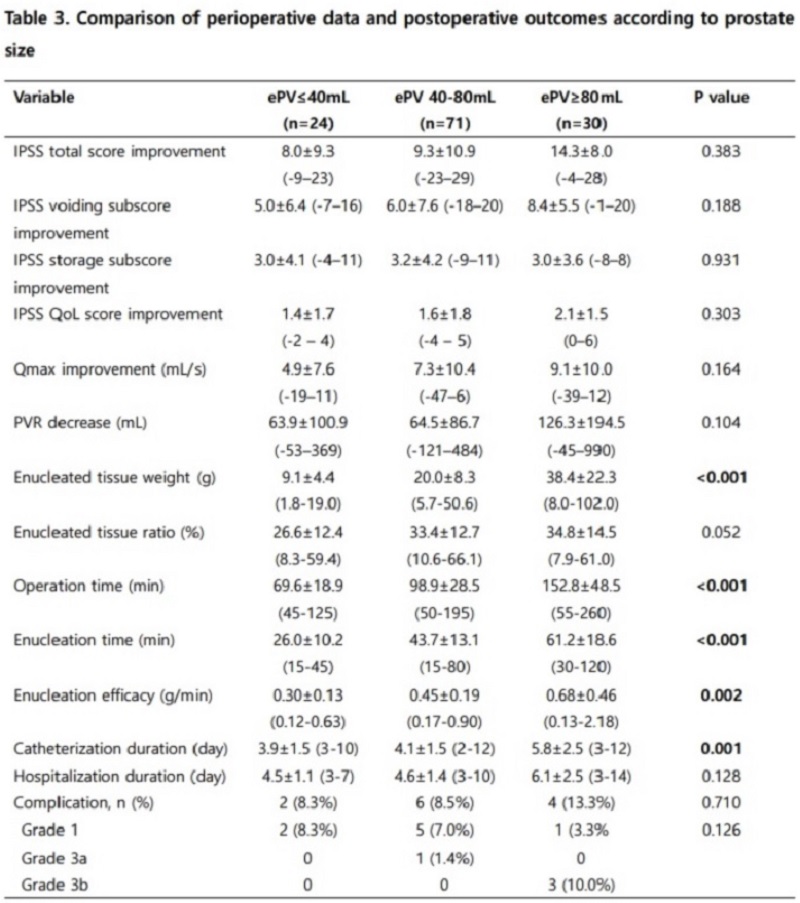
Introduction: Transurethral Enucleation with Bipolar (TUEB) using spatula loop has advantages for hemostasis during enucleation and tissue removal, giving a wide range of options. We compared the efficacy of TUEB using spatula loop according with prostate size. Methods: We retrospectively evaluated 519 patients who underwent TUEB at a single tertiary hospital between August 2018 and March 2022. Patients who were not evaluated for the International Prostate Symptom Score (IPSS) before or after the surgery or not followed up for =6 months after surgery were excluded. We divided 125 patients into three groups according to estimated prostate volume (ePV): =40mL (n=24), 40-80mL (n=71) and =80mL (n=30). The patient characteristics, IPSS, maximum flow rate (Qmax), post-void residual urine volume (PVR), and other data were compared before and after surgery in each group and between the groups. Results: A total of 125 patients were included in this retrospective study. Operation time, enucleation time, enucleated tissue weight and enucleation efficacy increased along with ePVs (all p<0.05). Catheterization duration was higher in men with ePV =80mL compared to other groups (p < 0.001). Duration of hospital stay and rates of complications were comparable among groups. The IPSS, IPSS-quality of life, Qmax and PVR improved after TUEB in all groups (all p<0.001), but they did not differ according to ePV. In the multivariable logistic regression analysis, prostate volume was not associated with postoperative complications. Conversely, patient’s antiplatelet/anticoagulation usage was only independently associated with postoperative complications (Hazard ratio [HR], 13.112; confidence interval [CI], 1.895-90.730; P=0.009). Conclusions: TUEB using spatula loop could be an effective treatment for patients with a small prostate, even though the efficacy was greater in those with a larger prostate. SOURCE OF Funding: None