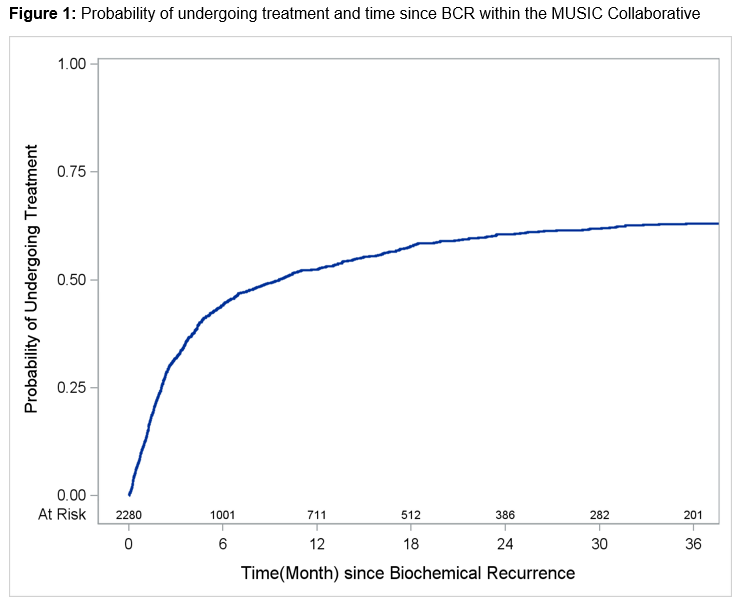
Introduction: Although many men remain disease free following radical prostatectomy (RP), some men will develop biochemical recurrence (BCR). Treating (BCR) is challenging as various patient and cancer factors, balancing the oncological benefit, and potential morbidity of treatment must be considered. Herein, we evaluated the use of salvage therapy in men with BCR in diverse, real-world practices. Methods: The MUSIC registry was queried for men undergoing RP between 3/2012 and 12/2021. Patients were included if they had an initial undetectable post-op PSA ( <0.1) and then experienced BCR with PSA >=0.2. Time to salvage treatment after BCR and probability of undergoing treatment were estimated using the Kaplan-Meier method. Type of salvage therapy was summarized based on PSA value at time of treatment (0.1-0.19, 0.2-0.5, 0.51-1.0, and >1.0). Practice-level variation on time to salvage treatment was also assessed among those with at least ten patients. Results: Of 17,755 patients who underwent RP in MUSIC, 2280 patients experienced BCR. Median time to BCR since RP was 9.0 months (IQR 1.7-23.8). Median length of follow up since BCR was 19.5 months (IQR 6.5-37.2). Probability of undergoing treatment sharply increased in the first 12 months following BCR, with 44% of patients getting treatment at 6 months, 52% at 12 months, and 61% at 24 months post-BCR (Figure 1). Among men receiving a salvage treatment, PSA before initiation of salvage therapy was 0.1-0.19 in 2.3% of patients, 0.2-0.5 in 58%, 0.51-1.0 in 15%, and >1.0 in 25%. Patients with higher PSA were more likely to receive systemic therapy (p < 0.001). Significant practice-level variation was observed on time to salvage treatment after BCR, with the percent of patients undergoing treatment at 6 months ranging from 20% to 70% among 24 practices (p < 0.001). Conclusions: The time from BCR and the PSA threshold used to trigger salvage treatment in men with BCR varies widely in MUSIC. This data may inform future quality improvement efforts aiming to decrease the variation in the PSA threshold used to initiate salvage therapy and the type of salvage therapy administered to men with BCR. SOURCE OF Funding: Blue Cross Blue Shield of Michigan