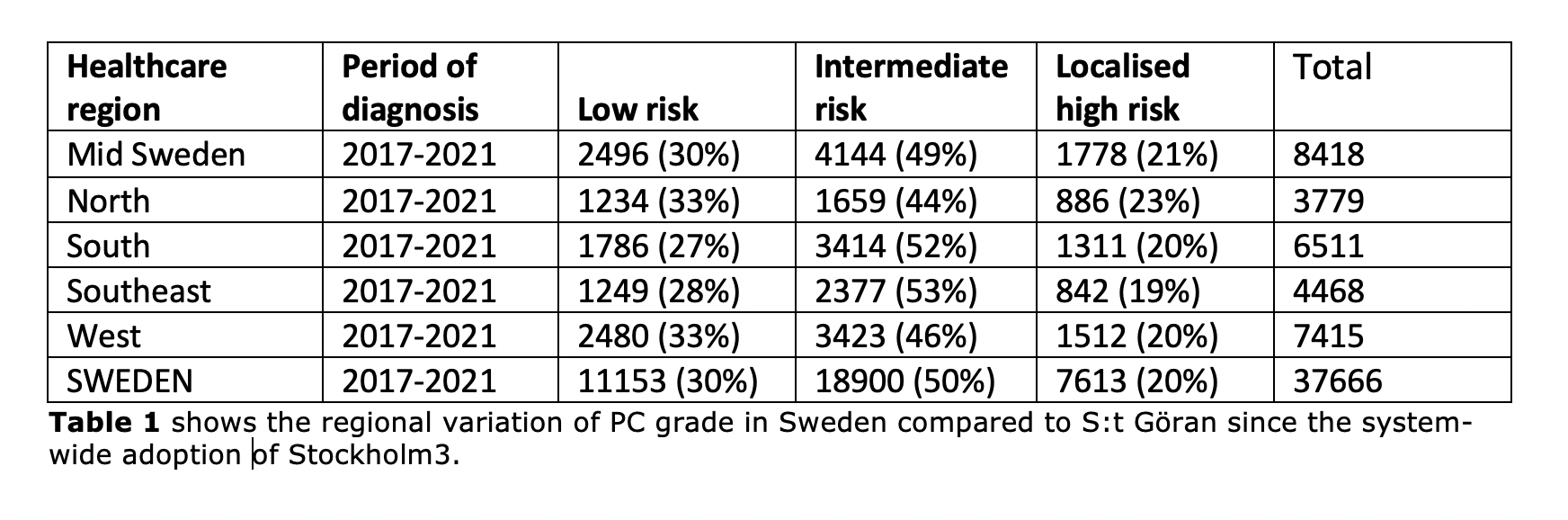
Introduction: Prostate cancer (PC) screening with PSA is controversial and level one evidence supports the use of MRI for PC detection, however as an upfront screening tool it may overwhelm the healthcare system. Stockholm3 has shown to aid in reduction of biopsies, over-detection, and number of MRIs while detecting similar number of clinically significant prostate cancers (csPC) as with using PSA and MRI. However, real world evidence of Stockholm3 with MRI is lacking. We aimed to describe Stockholm3 use with MRI in the largest PC center in Sweden. Methods: In 2017, the PC center incorporated the use of Stockholm3 as a reflex test for men with PSA levels >1.5 ng/mL between 45-75 years without a previous diagnosis of PC. Men with elevated Stockholm3 undergo a 16-minute bi-parametric MRI. Those with PI-RADS 3 lesions undergo targeted biopsies and men with PI-RADS 4-5 undergo a combination of targeted and systematic biopsies. Men with low or normal Stockholm3 risks are recommended to undergo blood sample in 6 or 2 years, respectively. We describe the PSA, Stockholm3, biopsy, MRI and pathology patterns within Capio S:t Göran. Data from the National Prostate Cancer Database was used to describe pathology from regions within Sweden. Results: In total 7,979 men underwent Stockholm3 testing, with a median age of 62 years (IQR: 55-68), median PSA of 2.0 ng/mL (IQR: 0.5-4.1) and median Stockholm3 of 5% (IQR: 3-11). Of those, 45% (n = 3,566) had low risk of csPC (Stockholm3 = 3), 28% (n = 2,202) had normal risk (Stockholm3 4-10) and 28% (n=2.196) had increased risk (Stockholm3 = 11%). Men with increased risk were referred to undergo MRI. If PSA >3 ng/mL cutoff was used, 30% (n = 2,318) would have been referred for MRI. Only men with a positive MRI were biopsied (PI-RADS = 3) and in total, 8% (n = 641) of the men were biopsied. Of those, 44% (n = 279) had PI-RADS 3 lesions, 28% (n = 177) had PI-RADS 4 lesions, 15% (n = 93) had PI-RADS 5 lesions and 14% (n = 92) were unable to obtain MRI. Of the biopsies, 33% (n = 212) were benign, 12% (n = 79) GG1, and 54% (n = 350) GG=2. Of the cancers (n=429), 18% were GG1, 69% (n = 296) were GG2-3 and 13% (n = 54) were GG=4 PC. Conclusions: We show the use of Stockholm3 as a reflex test can be used to aid in PC, reduce MRI utilization and reduce over detection of GG1 PC in a real-world setting. SOURCE OF Funding: Public health care system in Stockholm region Sweden