Session: PD39: Prostate Cancer: Detection & Screening V
PD39-10: The association between PSA density and the detection of clinically significant prostate cancer across all PIRADS scores in men with positive mpMRI. When PSA density can help avoiding prostate biopsy?
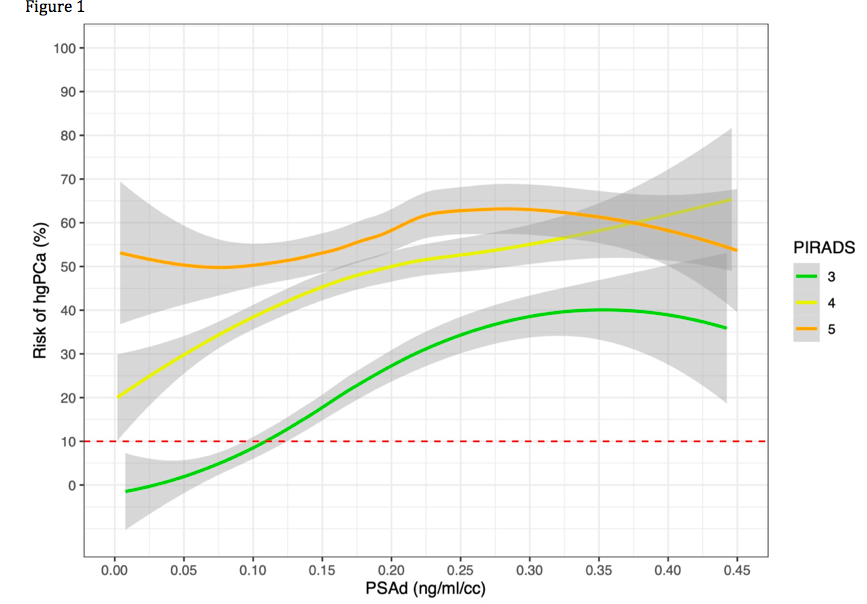
Introduction: Multiparametric MRI (MRI) has a high diagnostic accuracy for clinically significant PCa (csPCa). However, a significant proportion of patients with positive MRI still have negative biopsy. We hypothesized that PSA density (PSAd) may help to identify patients with positive MRI that might avoid biopsy. We investigated the entire range of PSAd to identify an adequate PSAd cutoff for this purpose. Methods: We included 1678 patients with positive MRI (PIRADS score =3) undergoing MRI-targeted plus systematic random prostate biopsies at our centre between 2016 and 2022. The outcome of the study was the detection of csPCa (Gleason score =7) at prostate biopsies. Multivariable model (MVA) was used to assess the association between PSAd and the risk of csPCa after accounting for confounders. We then plotted the risk of csPCa according to PSAd values and mpMRI results, using the LOWESS function. Results: Overall, 737 (44%) patients had csPCa at prostate biopsy. Patients with csPCa had lower prostate volume (40 cc vs 51cc), higher median PSA (7.1ng/mL vs 6.4ng/mL), and median PSAd (0.18 vs 0.12; all p<0.05). Overall, the csPCa detection in patients with PIRADS 3, 4, and 5 was 22% (n=127), 51% (n=389), and 65% (n=221), respectively. At MVA PSAd was strongly associated with the risk of csPCa at biopsy (OR: 1.1, p: 0.01) after accounting for potential confounders (PIRADS score, age, total number of cores, and number of targeted cores). Fig 1 shows the probability of harboring csPCa according to PSAd stratified by PIRADS score. Patients with PIRADS =4 had a risk of csPCa higher than 20% regardless of their PSAd values. Conversely, for patients with PIRADS 3 lesion and PSAd < 0.10, the csPCa detection was lower than 10%. Using this cutoff in patients with PIRADS 3 lesion at mpMRI, 101 (18%) biopsies could be avoided while missing only 8 csPCa (8%). Conclusions: Our analyses demonstrated that PSAd can be used to identify patients with suspicious prostate MRI that might avoid prostate biopsy given a low risk of csPCa. Patients with PIRADS 3 lesion and PSAd <0.10 can safely avoid biopsies. Conversely, the use of PSAd in patients with a visible PI-RADS 4-5 did not show any diagnostic benefit in identifying those men with lower risk of harbouring csPCa. SOURCE OF Funding: None