Session: PD39: Prostate Cancer: Detection & Screening V
PD39-12: Impact of Prostate-Specific Antigen testing pattern on cancer mortality among Black and White men diagnosed with prostate cancer: A large, urban health system cohort analysis
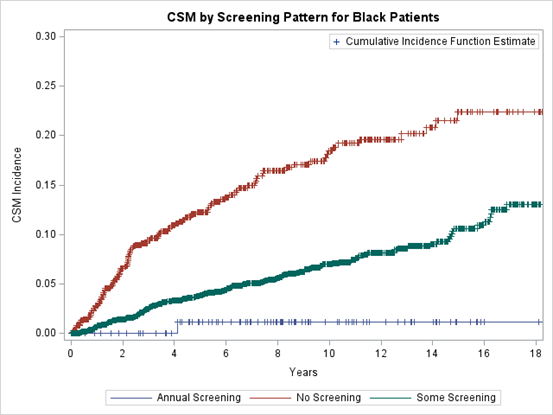
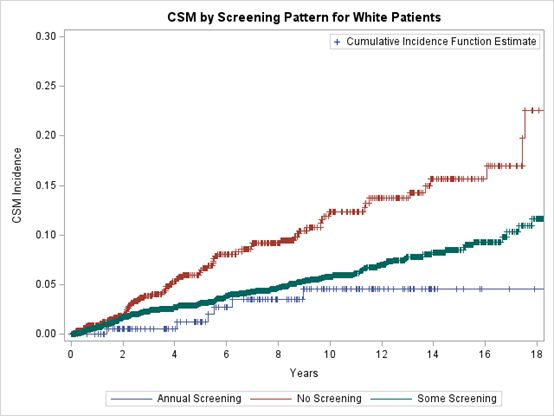
Introduction: Randomized studies addressing the role of prostate-specific antigen (PSA) screening on mortality in Black men are lacking. The aim of our study was to examine the impact of PSA on survival based on screening patterns and compare it between Black and White Men in a racially diverse North American population. Methods: This analysis included 6,378 Black and non-Hispanic White men with prostate cancer diagnosis who received care between the years 2000 and 2019, through our health system, and had at least one follow-up post diagnosis. For all patients, PSA testing data were examined categorically for the 5 years before diagnosis (going back to 1995) as follows: never, some (between 1-4 tests/5 years), and yearly testing (5 tests/5 years). The records were linked to Michigan Vital Records registry to certify survival status. Kaplan-Meier curves were used to estimate survival rate. Fine-Gray regression examined numerically the impact of PSA testing rate (from 0 to 5 years) on cancer-specific mortality (CSM), after accounting for available confounders. Results: Median (IQR) for age and PSA at diagnosis were 67.2 (60.8 - 73.8) years, and 5.8 (4.4 - 9.6) ng/ml, respectively. Yearly PSA testing was more frequent in White (5.2%) versus Black (3.2%) men (p value < 0.001). For the never, some and yearly testing categories, the 10-year cancer specific survival was respectively 87.7%, 94.2%, and 95.4% in Black men (p < 0.0001), and 81.5%, 93.0%, 98.8% in White men (p < 0.0001). On multivariable analysis, increased PSA testing rate prior to diagnosis was associated with more favorable CSM rates for Black men (HR: 0.14; 95% CI 0.08-0.23; p < 0.001) as well as White men (HR: 0.31; 95% CI 0.19-0.49; p < 0.001). Conclusions: In this retrospective cohort, more frequent PSA testing was associated with a reduced risk of CSM in both Black and non-Hispanic White men who were diagnosed with prostate cancer. SOURCE OF Funding: None