Session: PD41: Benign Prostatic Hyperplasia: Surgical Therapy & New Technology V
PD41-07: A novel outcomes categorization for current minimally invasive ejaculation-sparing treatments of benign prostatic hyperplasia: Results of a multicentric series
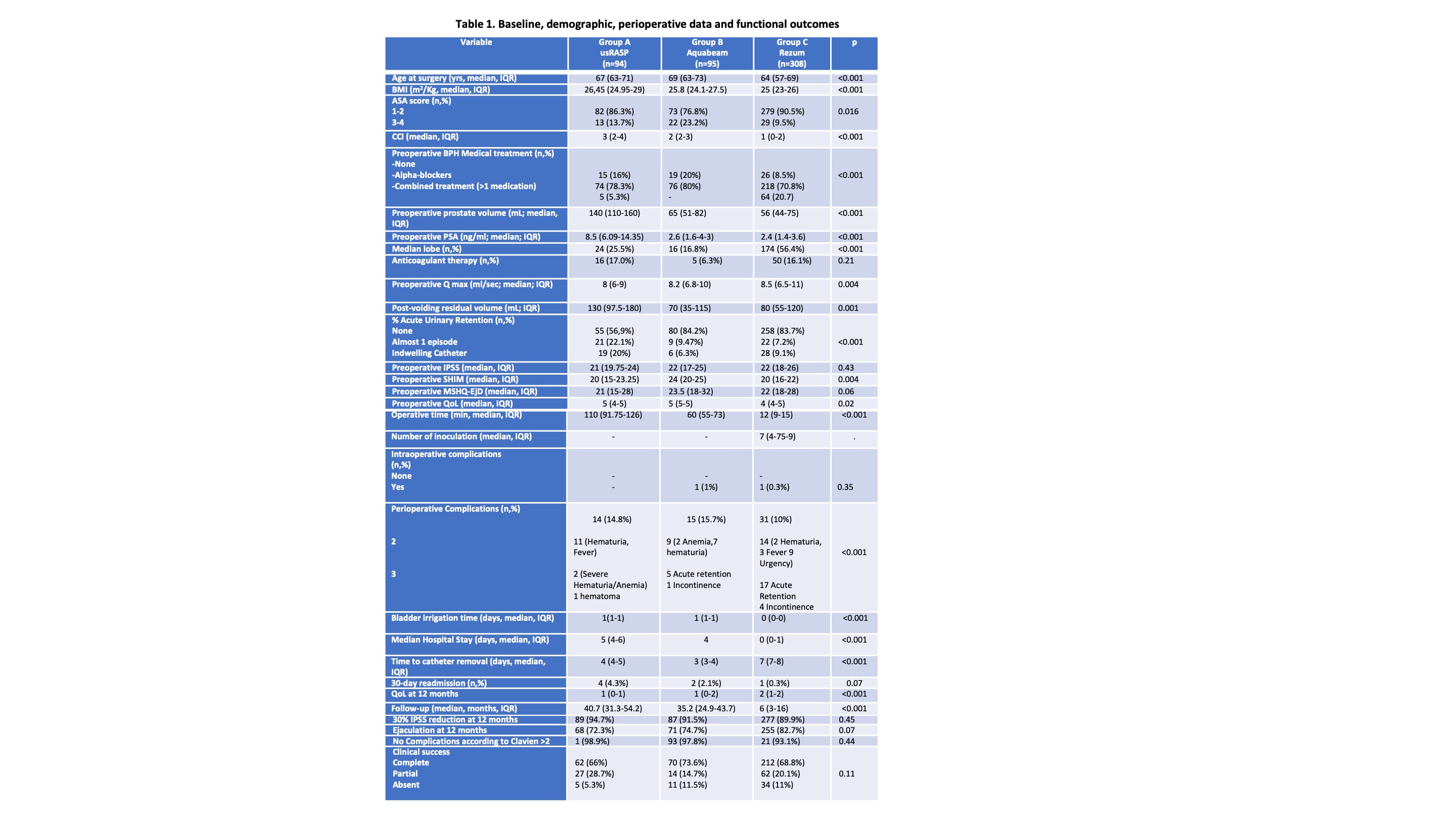
Introduction: We proposed a novel scoring system that summarizes composite outcomes for benign prostate hyperplasia (BPH) treatment and we sought to identify its predictors on a large multicentric dataset of minimally-invasive techniques Methods: Seven datasets were merged and queried for “urethral-sparing robotic simple prostatectomy” (usRASP; n=94; Group A), “waterjet ablation” (WA; n=95; Group B) and “Rezum” (n=308; Group C). Patients with a follow-up <12 months (n=32) or missing data (n=28) were excluded. “Complete clinical success” (CS) was defined as the coexistence of: 1) Reduction of =30% in International Prostatic Symptoms Score (IPSS) at 12 months compared to baseline; 2) Response to MSHQ-EjD-3 indicating ejaculation within 12 months during follow-up; 3) No perioperative complications=III on the Clavien-Dindo classification. Simultaneous achievement of only two of the presented criteria was considered a “partial clinical”success (PS). A logistic binary regression model was built to identify predictors of CS. Results: The median follow-up of the overall cohort was 39.8 months (IQR 27.1-46.8). In the A group a complete, partial, absent clinical success was observed in 66%, 28.7%, 5.3% of cases, respectively (Table 1). In the B group the complete clinical, partial and absent rates were 73.6%, 14.7%, 3.5% while in the C group were 68.8%, 20.1%, 11%, respectively (Table 1). No significant difference was found between groups for any of the CS endpoint considered (30% IPSS reduction; p=0.455, ejaculation rates; p=0.07, perioperative complications rates; p=0.445; Table 1). On multivariable logistic regression analysis, prostate volume <110 mL (OR 0.52; 95% CI 0.29-0.95; p=0.034), higher preoperative SHIM score (OR 1.07; 95% CI 1.03-1.11; p<0.001) and reduced catheterization time (OR 0.91; 95% CI 0.86-0.96; p=0.02) were independent predictors of complete clinical success Conclusions: We suggested a novel, comprehensive metric to assess 1-year composite outcomes, safety, and efficacy for any of minimally-invasive treatments for BPH. Irrespectively of the surgical technique considered, a preoperative prostate volume <110 ml and unimpaired sexual function are necessary conditions for expecting a complete clinical success SOURCE OF Funding: None