Session: PD41: Benign Prostatic Hyperplasia: Surgical Therapy & New Technology V
PD41-08: Device-Related Adverse Events During Benign Prostatic Hypertrophy Surgery: Review of the Manufacturer and User Facility Device Experience Database
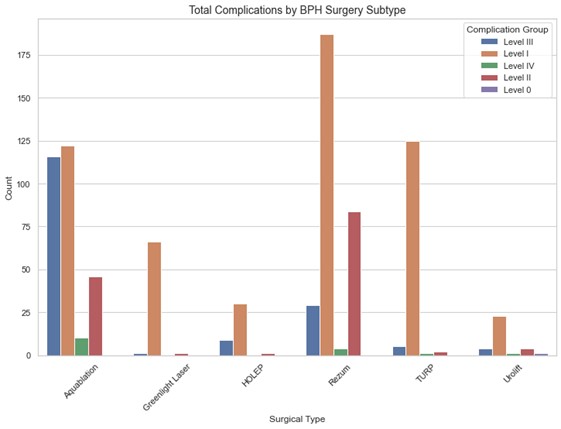
Introduction: Benign prostatic hyperplasia (BPH) affects most men over 60 years old. The Manufacturer and User Facility Device Experience (MAUDE) database is an FDA maintained public database that contains anonymous, voluntary medical device reports. Herein, we review device-related adverse events reported in the MAUDE database associated with BPH surgeries. Methods: The MAUDE database was queried for “Aquablation, Rezum, Loop Resection, Morcellator, Greenlight Laser, Holmium Laser, and Urolift” from 2018 through 2021. A complication classification system (Level 1-4) based on the Clavien-Dindo system was used to categorize events based on outcomes. These events were then correlated with device malfunctions and classified as “product related” and “non-product related.” Chi squared analysis was performed to identify associations between BPH surgery type and complication classification distribution. Results: A total of 873 device related events were identified. The entries by surgical subtype included: rezum 304 (35%), urolift 33 (4%), TURP 134 (15%), HOLEP 40 (4%), Aquablation 294 (34%), Greenlight laser 68 (8%). 553 complications (63%) were Level I (mild/none), 138 (16%) were Level II (medical management), 164 (19%) were Level III (surgical management), and 16 (2%) was Level IV (life threatening). The most common level II-IV complications by BPH surgery type: aquablation - hematuria (50%), rezum - lower urinary tract symptoms (23%), HOLEP – retained adenoma (23%), urolift – acute urinary retention (12%), greenlight laser – urethral necrosis (2%), transurethral resection of prostate – bladder perforation (3%). Using chi squared analysis, aquablation (p < 0.017) and Rezum (p < 0.012) were associated with the highest risk of Level II-IV complications compared with other device classes. Overall, “product related” malfunctions were not associated with level II-IV complications. Conclusions: Aquablation and rezum were associated with a higher proportion of level II-IV complications. However, this difference is not accounted for by “product related” malfunctions, which highlights surgeon experience or other unknown factors as potential sources for adverse events with newer products. A limitation of this study is the total complications per surgical subtype are not fully captured. SOURCE OF Funding: None