Session: PD41: Benign Prostatic Hyperplasia: Surgical Therapy & New Technology V
PD41-12: Perioperative Complications and Outcomes of Patients Undergoing Aquablation for Benign Prostatic Hyperplasia: A Single Tertiary Referral Center Experience in 146 patients
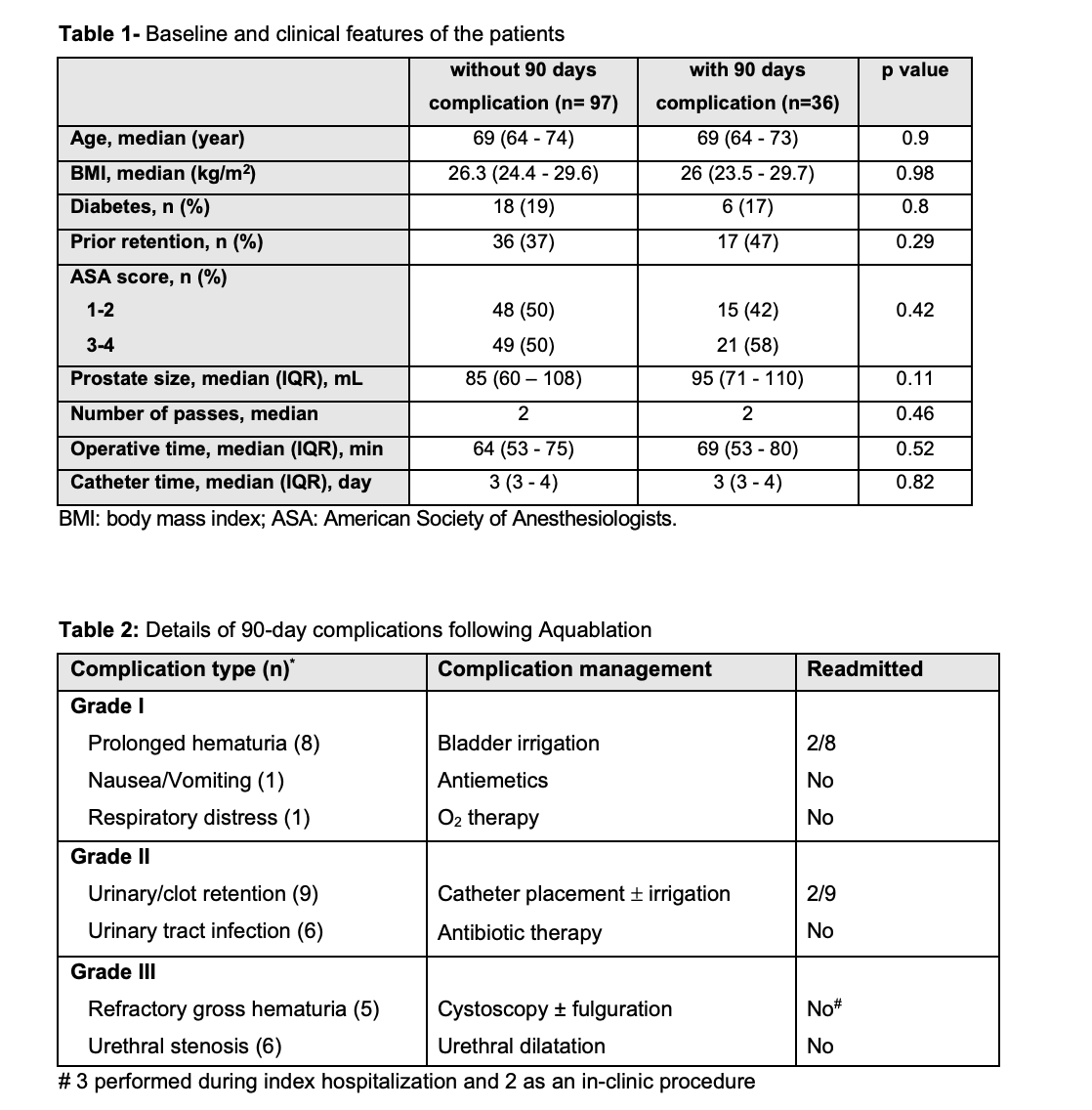
Introduction: Most published data with Aquablation, a recently introduced minimally-invasive technology for management of patients with benign prostatic hyperplasia (BPH), is from 2 large multicenter trials. The aim of this study is to report post-commercialization perioperative complications and outcomes of Aquablation from a single institution. Methods: Using our IRB-approved database, we retrospectively reviewed the records of consecutive patients who underwent Aquablation for BPH in our institution between August 2020 and June 2022. Those with no available 90-day data were excluded. Primary and secondary outcomes were 90-day complications (graded by Clavien-Dindo classification) and 90-day readmission, respectively. Specific focus was placed on hemorrhagic complications. Univariate and multivariable logistic regression were performed to assess the factors affecting the 90-day complications. Results: Among 146 patients who received Aquablation during the study timeframe, 133 patients with a median (IQR) age of 69 (64 – 73) years and median (IQR) prostate size of 85 (65 – 109) mL were included in the analysis. Baseline and clinical features of the patients are presented in Table 1. Median operative time was 64 minutes, and no intraoperative complication/blood transfusion was recorded. Median length of hospital stay and catheter time were 1 and 3 days, respectively. 90-day complications were recorded in 36 patients (27%) with a Clavien 3 in 11 patients (8%). A bleeding event was recorded in 5 patients (4%) of whom 4 required cystoscopic fulguration (Table 2). Average drop in postoperative hemoglobin was 1.5 gm/dL, yet no patient required peri-operative blood transfusions. The readmission rate was 4.5% (6/133). Two patients underwent re-treatment (transurethral resection of the prostate). On multivariable analysis, prostate size was not independently associated with 90-day complications (OR 1.02, 95% CI 0.99 – 1.03, p = 0.07). Conclusions: Aquablation is safe with a 27% overall complication rate that is independent of patient or prostate factors. Bleeding rate with incorporation of selective cautery hemostasis has dropped compared to the Water and Water 2 trial data. SOURCE OF Funding: None