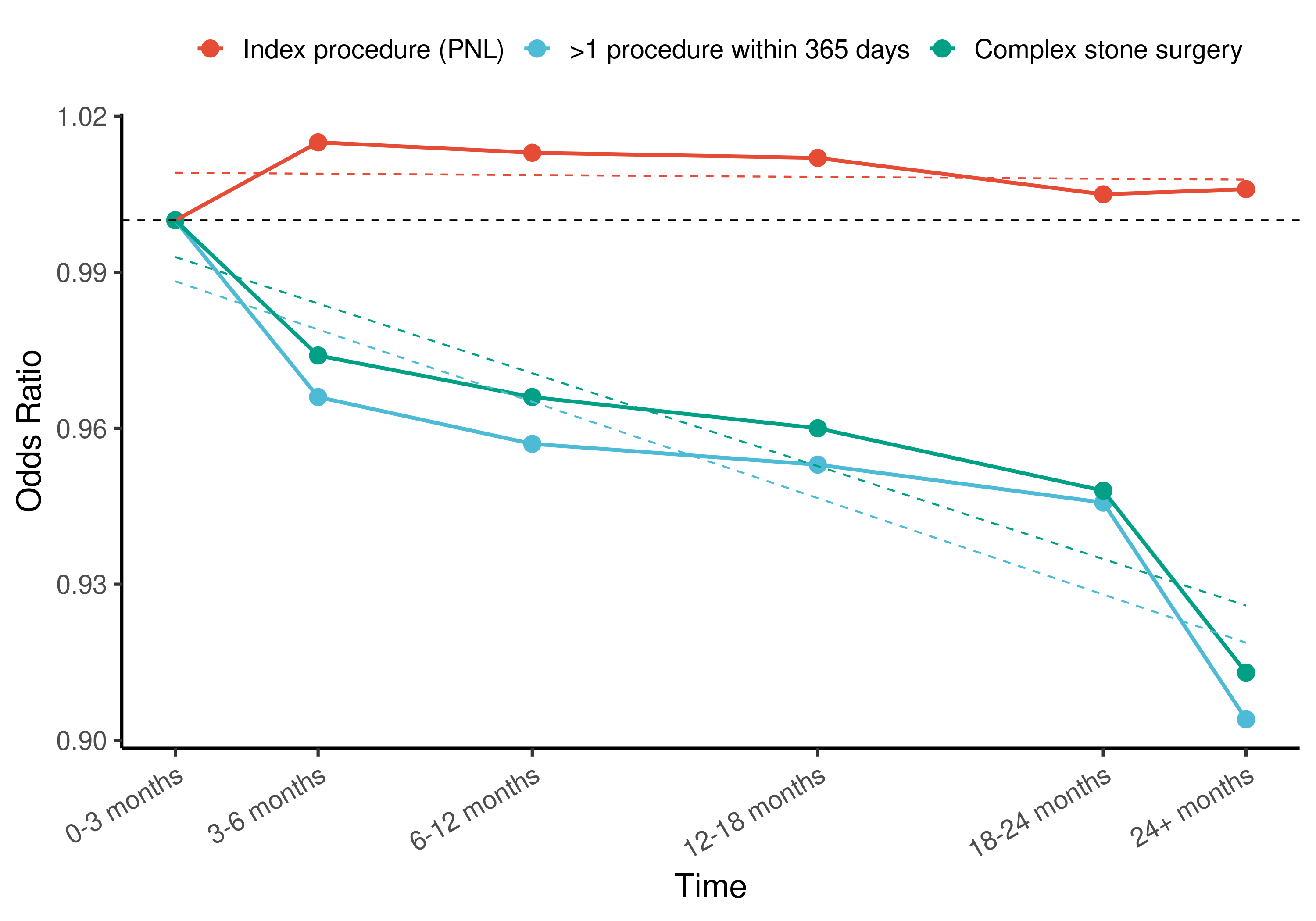
Introduction: Kidney stones are known to grow over time and delays between emergency department visits and surgical care are associated with more complex surgical intervention. As such, the objective of this study is to investigate the effect of the wait times from urology clinic visits to surgery on the eventual complexity of kidney stone surgery. Methods: Urologic visits were identified using The AUA Quality (AQUA) Registry. Subsequently, adults (age = 18) having a diagnosis of nephrolithiasis and undergoing = 1 urologic stone procedure were identified. These patients were then followed for at least 365 days after their index surgery to determine the total burden of procedures. Any patients without 365 days of follow-up were excluded. Our outcomes were defined as percutaneous nephrolithotomy (PNL) vs. non-PNL index surgery, undergoing more than 1 urologic procedure within 365 days, and receipt of complex surgery (PNL as index surgery or > 1 procedure within 365 days). Each outcome was analyzed using a multivariate logistic model with wait times as predictor controlling for age, gender, race, insurance, social deprivation index, obesity, diabetes, and flomax prescription. Results: A total of 137,477 patients underwent = 1 urologic stone procedure. Of these, 6,497 (4.7%) patients underwent index PNL and 40,968 (29.8%) patients underwent more than 1 procedure within 365 days. Stratifying patients by index procedure type revealed highers odds of undergoing PNL for any wait time (ref: 0-3 months) but little change was observed as wait times increased (slope = 0.0005, P = 0.29). Odds of undergoing multiple procedures (slope = -0.0035) and receipt of complex stone surgery (slope = -0.0031) both showed a decreased trend as wait times increased (P < 0.001). Conclusions: Increased surgical wait times is generally expected to lead to worse outcomes due to disease progression in the patients. Paradoxically, we show that an increasing time interval from urologic clinic visits to surgical treatment associates with lower odds of complex surgery. Therefore, time from diagnosis to evaluation by a urologist may be the rate-limiting step in the time course of kidney stone treatment. And reducing this time may reduce previously recognized disparities in the eventual need for complex kidney stone surgery. SOURCE OF Funding: K12DK111028