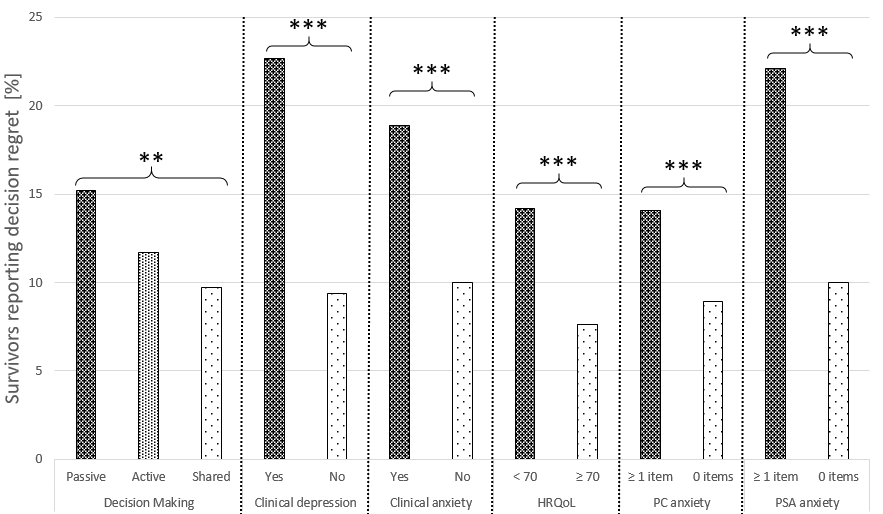
Introduction: A variety of therapeutic options are available for localized prostate cancer (PC). Choosing the most suitable treatment option can be difficult and requires weighing up against respective side effect profiles. Following radical prostatectomy (RP), PC survivors may experience regret regarding their initial choice of treatment. While long-term impact of functional outcomes on decision regret has been studied extensively, the role of psychosocial factors on decision regret is less understood. The current study aimed to investigate the prevalence and determinants of decision regret in long-term PC survivors following RP. Methods: A total of 3,408 PC survivors (mean age 78.8±6.5 years, mean time since RP 16.5±3.8 years) from the multicenter German Familial PC Database returned questionnaires. Current decision regret was assessed with one item from the Decision Regret Scale. Validated measures were used to assess treatment decision making, health-related quality of life (HRQoL), PC anxiety, PSA anxiety, general anxiety, and depressive symptoms. Multivariable logistic regression analyses were used to determine variables independently associated with decision regret. Results: Here, 10.9% (373/3408) of PC survivors reported decision regret. Figure 1 depicts the percentage reporting regret by psychological parameters and HRQoL. On multivariable regression, organ-confined disease at RP (OR 1.39, 95%CI: 1.02-1.91), biochemical recurrence (OR 1.34 95%CI: 1.00-1.80), low HRQoL (OR 1.69, 95%CI: 1.28-2.24), depressive symptoms (OR 2.32, 95%CI: 1.52-3.53), and PSA anxiety (OR 1.88, 95%CI: 1.17-3.01) were significantly associated with decision regret. Shared-decision making was associated with a lower risk of regret than passive-decision making. (OR 0.59, 95%CI: 0.41-0.86). Conclusions: The findings underline that PC survivors may experience decision regret even after 16 years following RP. Promoting shared-decision making may help mitigate long-term regret. Awareness regarding patients showing signs of clinical depression or PSA anxiety should be encouraged to identify patients at risk of decision regret in need of additional support. SOURCE OF Funding: none