MP63-13: Trials in Progress: A Phase I/II Trial of Intravesical Chemoimmunotherapy with Gemcitabine and Bacillus Calmette-Guérin (BCG) for Patients with BCG-Exposed High-Grade Non-Muscle Invasive Bladder Cancer (NMIBC)
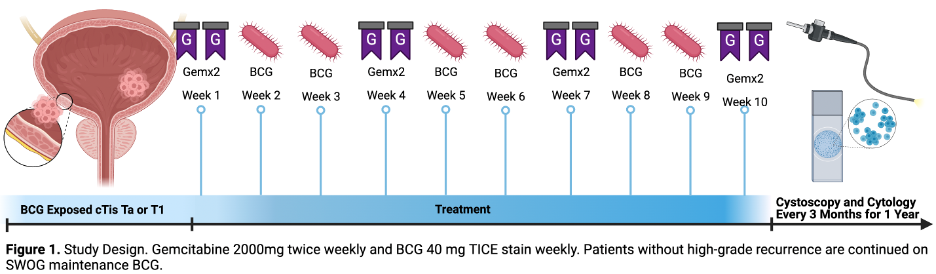
Introduction: The standard of care for high-risk NMIBC after exposure to induction only BCG or relapse >12 months after “adequate” BCG is retreatment with BCG. However, ~50% will relapse within 6 months. Intravesical Gemcitabine (GEM) is a well-tolerated, common treatment for NMIBC with better efficacy after BCG than mitomycin C which may synergistically enhance the efficacy of BCG by augmenting the immune tumor microenvironment. We are evaluating gemcitabine and BCG (GemBCG) intravesical chemoimmunotherapy to address the need for more effective and less toxic bladder preserving treatments by enhancing BCG efficacy. Methods: This is an investigator-initiated Phase I/II trial of GemBCG for BCG-exposed NMIBC enrolling patients with BCG-exposed carcinoma in-situ (CIS ±Ta/T1) that recurred within 24 months of last BCG (BCG-exposed/BCG-relapsing NMIBC, Figure 1). Patients with BCG-unresponsive disease, contraindication to BCG, or prostatic/ureteral urothelial disease are excluded. The primary endpoint for Phase I was safety and dose tolerability. The primary endpoint for Phase II is clinical complete response (CR) at 6 months (absence of high-grade disease on cystoscopy/TURBT and negative cytology). Using a Simon’s optimal 2-stage design testing the null hypothesis of a true CR of 55% at 6 months (based on historical outcomes of BCG alone) we plan to enroll 19 and 24 patients in the first and second stage, respectively. Phase I patients treated at the maximum tolerated dose (MTD) are included in phase II. Secondary outcomes include recurrence progression, and cystectomy-free survival. Correlative studies explore immune and molecular predictors of response and resistance to chemoimmunotherapy in tumor tissue, urine, and blood. Results: Of the 25 patients who completed Phase I, 14/25 were treated at the MTD and processed to Phase II. Treatment was well-tolerated (no treatment related grade =3 adverse events) and demonstrated promising early efficacy (95% [19/20] CR at 6-months). Conclusions: A combination of intravesical GEM and BCG appears safe and well tolerated in patients with BCG-relapsed/BCG-exposed NMIBC. Promising early efficacy data requires completion of Phase II for confirmation (NCT04179162). SOURCE OF Funding: N/A