Resident Physician University of Wisconsin School of Medicine and Public Health
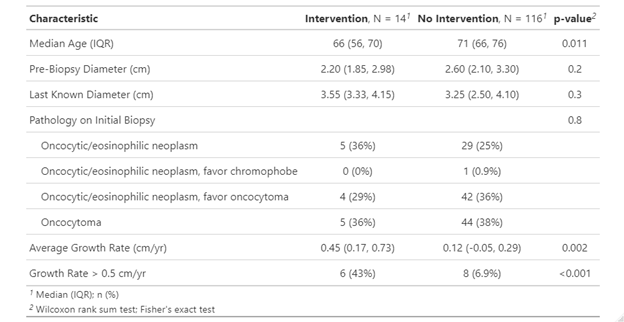
Introduction: Oncocytic renal neoplasms are slow growing tumors with minimal metastatic potential and may be ideal for management with active surveillance. However, few data are available describing surveillance outcomes or need for delayed intervention. The purpose of this study was to evaluate outcomes for patients diagnosed with renal oncocytic neoplasms treated with active surveillance. Methods: A prospectively maintained renal biopsy database was used to identify patients who were diagnosed with renal oncocytic neoplasms from 2006-2021. Baseline characteristics, treatment history, and follow-up imaging characteristics were collected as shown in table. Active surveillance (AS) was defined as at least 6 months with follow-up imaging. Results: 130 tumors in 122 patients were followed with surveillance imaging. Median follow-up was 50 months (IQR 28.3-83). A second biopsy was concordant in 19/20 patients (95%) with one patient found to have clear cell renal cell carcinoma (ccRCC) after the original biopsy had shown oncocytoma. Average growth rate of the entire cohort was 0.14 cm/year. 14 tumors (11%) had growth rates greater than 0.5 cm/year. Delayed intervention was utilized in 14 (11%) patients including 13 treated with percutaneous thermal ablation and one patient treated with nephrectomy (confirmatory biopsy demonstrated ccRCC). Median time from biopsy to delayed intervention was 37 months (IQR 13-40), which was more likely in younger patients (median age 66 versus 71, p = 0.01) with faster growing tumors (0.45 cm/year versus 0.12 cm/year, p=0.002) shown in Table. Pre-biopsy diameter was not associated with delayed intervention (2.2 cm vs 2.6 cm, p=0.2) nor was last known renal mass diameter (3.55 vs 3.25, p=0.3). Zero patients developed metastatic cancer or died from metastatic renal cancer. Conclusions: Biopsy-diagnosed renal oncocytic neoplasms are ideal for active surveillance given excellent cancer specific outcomes. Ten percent of patients were treated with a delayed intervention, which was more common in younger patients with tumor growth > 0.5cm/year. SOURCE OF Funding: N/A