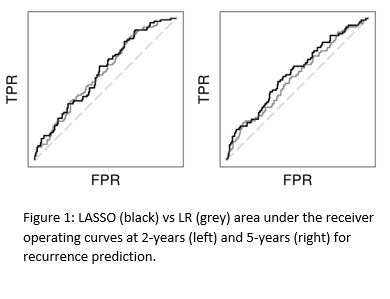
Introduction: While 24-hour (24H) urine studies offer insight into the metabolic profile of recurrent stone formers, their use towards predicting stone recurrence events is limited. We sought to assess the prediction of symptomatic kidney stone recurrence episodes using machine learning models. Methods: We trained three separate machine learning (ML) models (least absolute shrinkage and selection operator regression [LASSO], random forest [RF], and gradient boosted decision tree [XGBoost] to predict symptomatic kidney stone recurrences from electronic health-record (EHR) derived features and 24H urine data. ML models were compared to logistic regression [LR]. We evaluated all patients with an index stone treatment at our institution and a 24H urine test performed (N=1231). A manual, retrospective review was performed to evaluate for a symptomatic stone event, defined as pain, acute kidney injury or recurrent infections attributed to a kidney stone identified in the clinic or the emergency department, or for any stone requiring surgical treatment. We evaluated performance using area under the receiver operating curve (AUC-ROC) and identified predictors for each model. Results: The 2- and 5- year symptomatic stone recurrence rates were 25% and 31%, respectively. The LASSO model (Figure 1) performed best for symptomatic stone recurrence prediction (2-yr AUC: 0.62, 5-yr AUC: 0.63). The other models demonstrated modest overall performance at 2- and 5-years: LR (0.585, 0.618), RF (0.570, 0.608), and XGBoost (0.580, 0.621). Top prioritized features among all models included age, diabetic status, stone composition and urine pH. Additionally, the LASSO model prioritized BMI and history of gout for prediction. Conclusions: Throughout our cohorts, ML models demonstrated comparable results to that of LR, with the LASSO model outperforming all other models. Further model optimization should incorporate 24H urine testing and EHR-derived features. SOURCE OF Funding: Vanderbilt CTSA Grant UL1TR002243