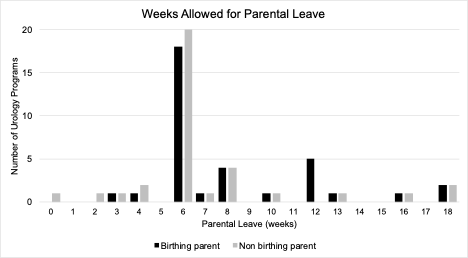
Introduction: Parental leave is a significant consideration for resident physicians when considering family planning during training. While the American College of Graduate Medical Education (ACGME) recently mandated a 6-week paid parental leave policy, there is no standardized parental leave policy across urology residency programs. This study sought to evaluate the availability and accessibility of parental leave for urology residents at academic medical institutions in the United States. Methods: A non-validated 8-question survey was developed to capture the current status of parental leave policies (e.g. duration of leave, maternal vs paternal leave, birth vs adoptive children, compensation status). All ACGME-accredited urology residency programs were contacted via email. Data were collected via telephone/video interview, email, or online survey response. Program characteristics and demographic information were collected from the residency program website and Fellowship and Residency Electronic Interactive Database Access (FREIDA). Fisher’s exact test was used to determine association between program characteristics and favorable parental leave policies (i.e., >6 weeks). Results: We successfully contacted 132 (93.6%) academic urology programs. A total of 35 (27%) programs responded. Maximum allowed weeks of parental leave ranged 3-18 weeks for birthing parents (median 6 weeks, mean 8.26 +/- 3.78 weeks) and 0-18 weeks for non-birthing parents (median 6 weeks, mean 7.06 +/- 3.83 weeks). Most institutions provided fully paid leave and did not require exhaustion of other time away from training (i.e., vacation or sick leave; 74.3% and 71.4% respectively). Having >30% female faculty was associated with resident parental leave time >6 weeks (OR 10.3, p<0.05). Geographic region, program type (university- vs community-based), program size, number of program years, and resident gender complement were not associated with parental leave time. Conclusions: There is large variability in the maximum amount of parental leave allowed and amount of paid leave among academic urology residency programs across the United States. Standardization of these policies may increase equity across urology residencies in the U.S. and alleviate fears of financial burden and need to extend training. SOURCE OF Funding: N/A