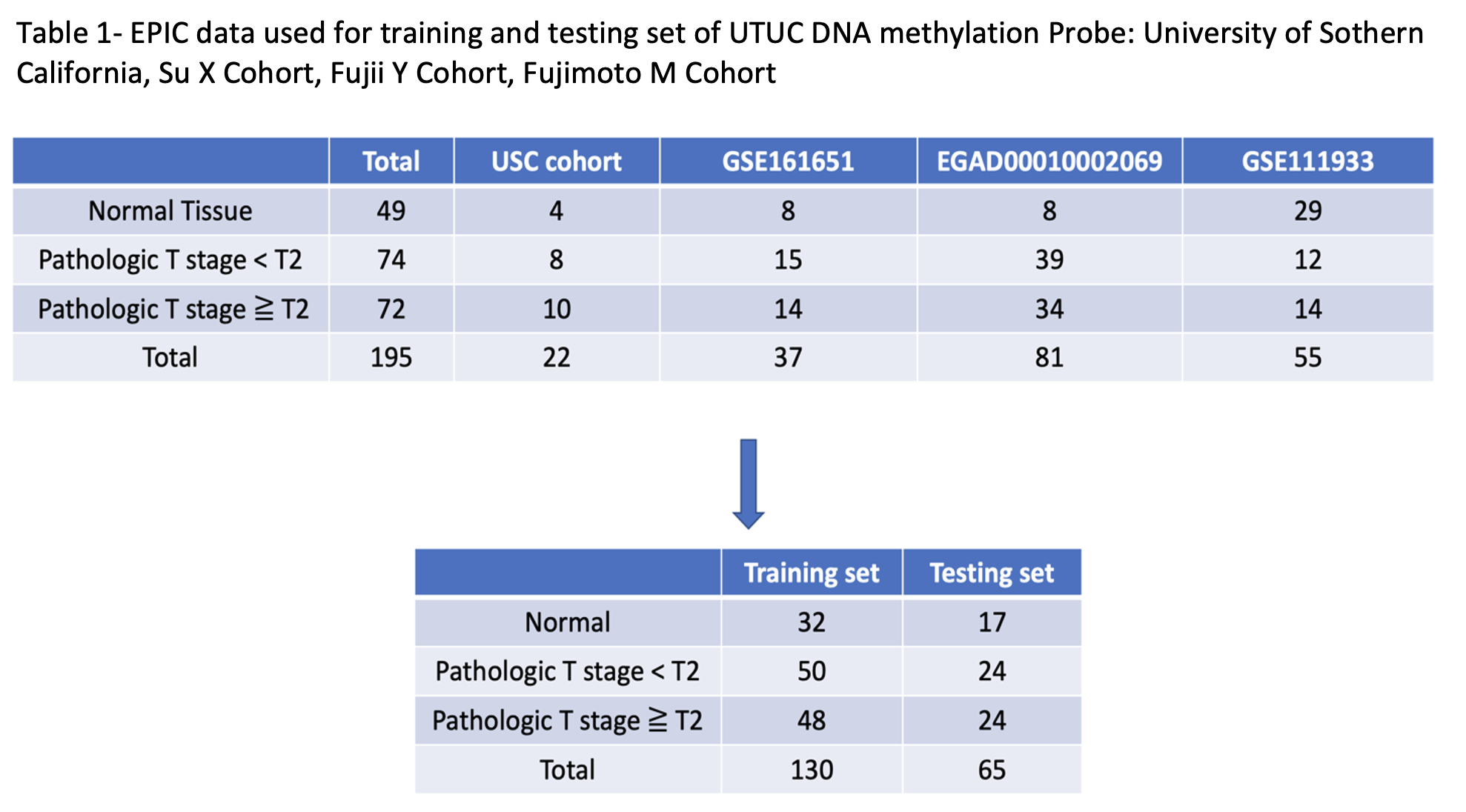
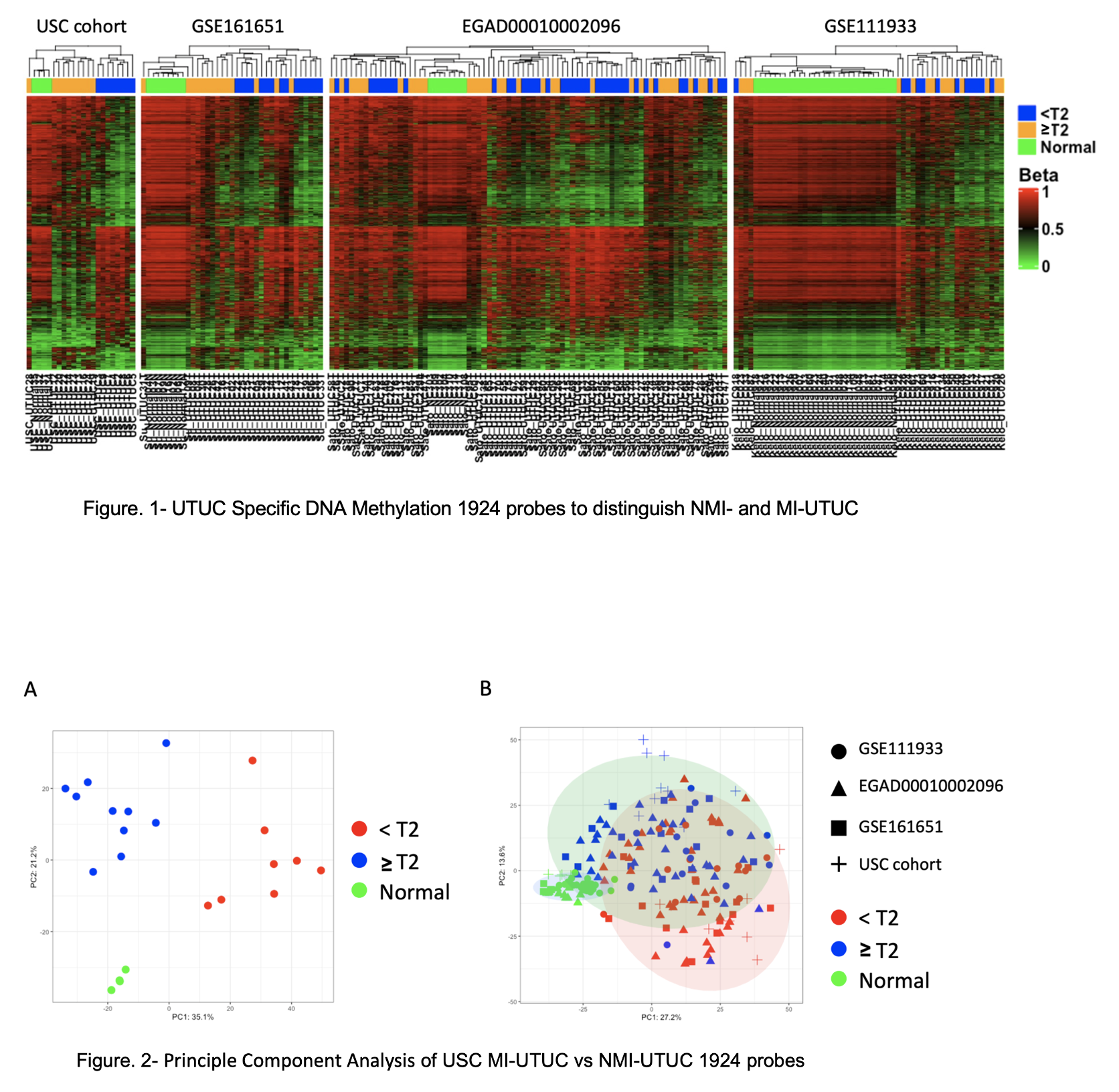
Introduction: Upper tract urothelial carcinoma (UTUC) is an uncommon, yet biologically heterogeneous disease that accounts for 5-10% of all urothelial tumors. The diagnosis and risk-stratification of UTUC patients is challenging given the limitations of current diagnostic tools. DNA methylation has emerged as a potential prognostic and diagnostic factor in urothelial carcinoma, yet few studies have examined its role in UTUC. In this study, we aim to identify specific tissue DNA methylation markers in muscle invasive (= pT2) and non-muscle invasive (< pT2) UTUC cases. Methods: Microdissection and DNA extraction of over 300 slides were performed and the EPIC work was completed on all USC samples-including 8 non-muscle invasive, 10 muscle invasive and lymph node positive samples and 4 normal tissue/WBC as controls. Methylation patterns were analyzed and compared between non-muscle invasive (NMI) and muscle invasive (MI) UTUC samples. Table 1 shows epics from other centers were also included in the study. A training set including epic data of 32 normal samples, 50 non-muscle invasive (NMI), and 48 muscle invasive samples (MI) was used to design the probe, and Epic data of 65 samples including 17 normal tissue, 24 NMI and 24 MI samples were used as testing samples. Principle component analysis (PCA) was used to cluster the UTUC and normal samples. Results: Different patterns of methylation were detected in NMI versus MI-UTUCs. By comparing adjacent normal tissues and white blood cells (WBCs), specific DNA methylation probes were developed for NMI-UTUC and MI-UTUCs (Figure 1). According to PCA, MI-UTUC vs NMI-UTUC 1924 probes is able to cluster the UTUC samples (|deltaMedian| > 0.3, p < 0.05) (Figure 2). Conclusions: UTUC has a distinct DNA methylation pattern that is distinguishable from normal urothelial tissue. UTUC-specific DNA methylation probes can be used to differentiate muscle-invasive UTUCs. SOURCE OF Funding: University of Southern California Urology research council