Session: MP69: Bladder Cancer: Upper Tract Transitional Cell Carcinoma I
MP69-06: Characteristics of upper urinary tract urothelial carcinoma deficient in Lynch syndrome-related mismatch repair gene expression protein on immunohistochemistry
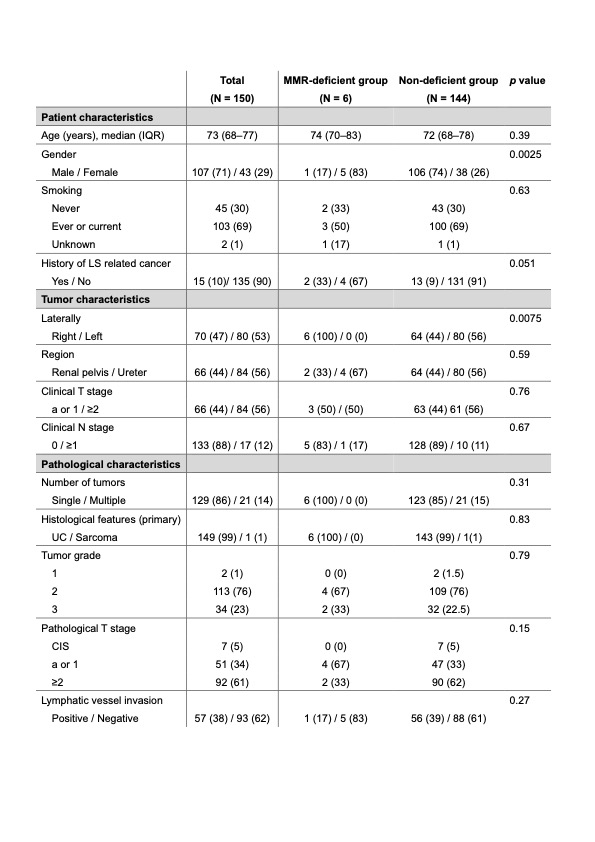
Introduction: Lynch syndrome (LS) is an autosomal formed inherited disorder that is a susceptibility syndrome for several cancers. Four mismatch repair (MMR) genes (MLH1, MSH2/6, PMS2) are thought to be involved in LS. Colorectal cancer, a representative cancer of LS, is known to develop at a younger age and have a better prognosis than non-LS colorectal cancer. Upper urinary tract urothelial carcinoma (UTUC) is third major cancer that occur with increased frequency in LS, but details are not well known. In this study, we examined MMR gene-related protein defects on immunohistochemistry (IHC) in UTUC and analyzed their characteristics. Methods: A total of 150 consecutive patients with UTUC who underwent surgical resection between February 2012 and December 2020 at National Cancer Center Hospital East (Chiba, Japan) were included in this study. The expression of four MMR gene-related proteins was examined by IHC, and the association with clinical and oncological characteristics was analyzed retrospectively. Results: Six patients (4%) were found to be deficient in some MMR gene-related protein on IHC. Three patients were deficient in MSH2 and one patient each in MLH1, MSH6 and PMS2. No patient had more than 2 deficiencies. The median age was 74 years for the MMR-deficient group and 72 years for the non-deficient group. Compared to the non-deficient group, the MMR-deficient group had more female (83% vs 26%; p = 0.0025) and right-side tumor (100% vs 44%; p = 0.0075). History of LS-related cancer tended to be more in the MMR-deficient group (33% vs 9%; p = 0.051). (Table) There were no differences in pathologic characteristics nor oncological outcome between the two groups. Of the 150 patients, 4 met Amsterdam Criteria II. One of them showed MSH2 gene-related protein defects, while the other three had no MMR defects. Five patients did not meet Amsterdam Criteria II but showed some MMR defect. One female patient with a history of colorectal cancer was genetically diagnosed with LS who had mutation in MLH1, did not meet Amsterdam Criteria II, but was deficient in MLH1-related protein. Conclusions: The characteristics of LS-related UTUC may be different from those of LS-related colorectal cancer. The impact of LS in UTUC remains unclear and requires a large-scale study. SOURCE OF Funding: None