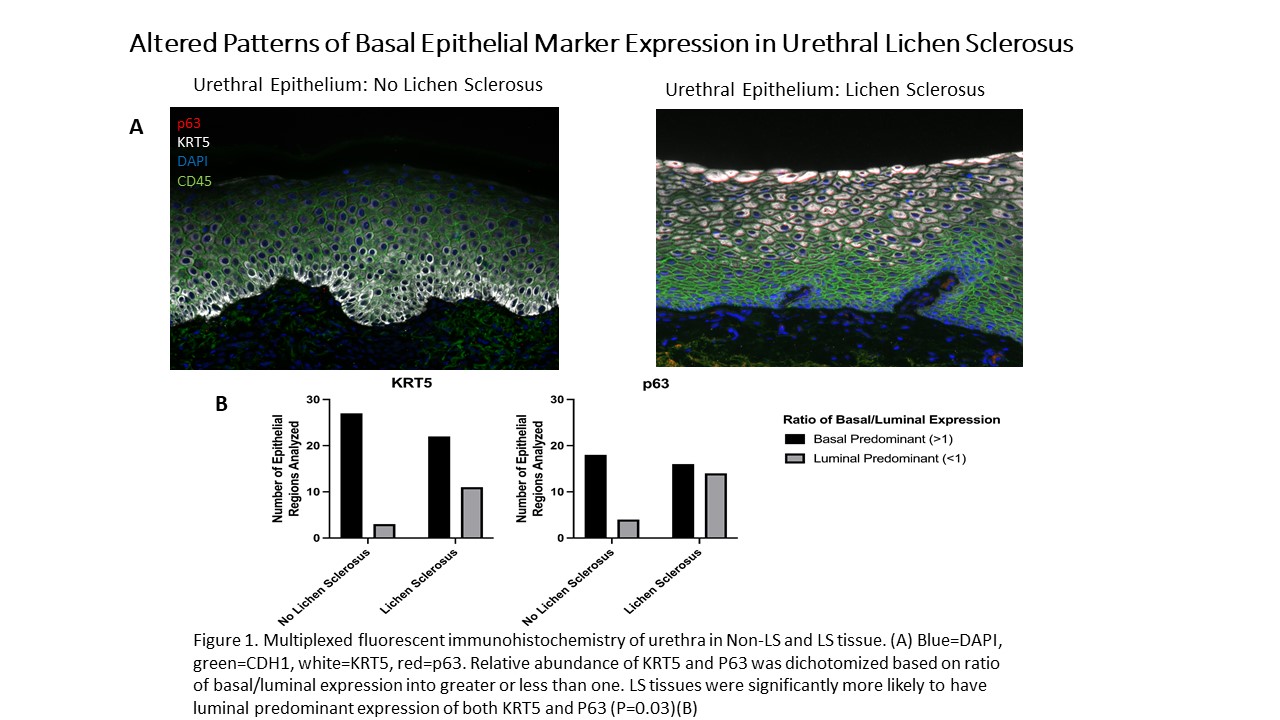
Introduction: Lichen sclerosus (LS) is an idiopathic chronic inflammatory disease of the genital epithelium resulting in fibrosis and severe urethral stricture disease in affected men. Epithelia are subdivided into basal, intermediate, and superficial cell layers which are defined by protein expression patterns. Loss of basal cell differentiation is a feature of other fibrotic disorders but have not been studied in the urethra or LS. The proteins keratin 5 (KRT5) and p63 have been reliably established as basal cell markers in urothelium. Therefore, we hypothesized that urethral epithelium affected by LS would have decreased basal expression of KRT5 and p63. Methods: Urethral tissue after urethral biopsy or urethroplasty was examined by a genitourinary pathologist to determine LS status. Using multiplexed fluorescent immunohistochemistry, KRT 5, CD45, p63, and DAPI were stained and three epithelial regions imaged per specimen. Using QuPath analysis software, the epithelium was segmented into basal and luminal compartments and relative abundance (RA) of each primary antibody was measured (number of positive cells/number of nucleated cells). RA was compared with respect to LS status and basal/luminal compartment using a Mann-Whitney U test. Results: We analyzed 14 slides (n=7 LS, n=7 non-LS). The RA of KRT5 and p63 positive cells were similar with respect to epithelial versus basal compartment and LS status. However, we noted a change in patterning such that LS tissues displayed a shift of KRT5 and p63 expression from the basal to the luminal epithelium. To quantify this, we compared the ratio of basal to luminal KRT5 and p63 expression and dichotomized this as “basal predominant” (>1) or “luminal predominant” ( <1). LS urethra were significantly more likely to have luminal predominant expression of p63 and KRT5 compared to non-LS (p=0.03, p=0.03) (Figure). Conclusions: We identified a change in expression pattern of basal epithelial markers (KRT5 and p63) in LS urethra. Altered epithelial differentiation is seen in other inflammatory diseases and may be implicated in the pathogenesis of LS. SOURCE OF Funding: K12DK100022NIH/NIDDK