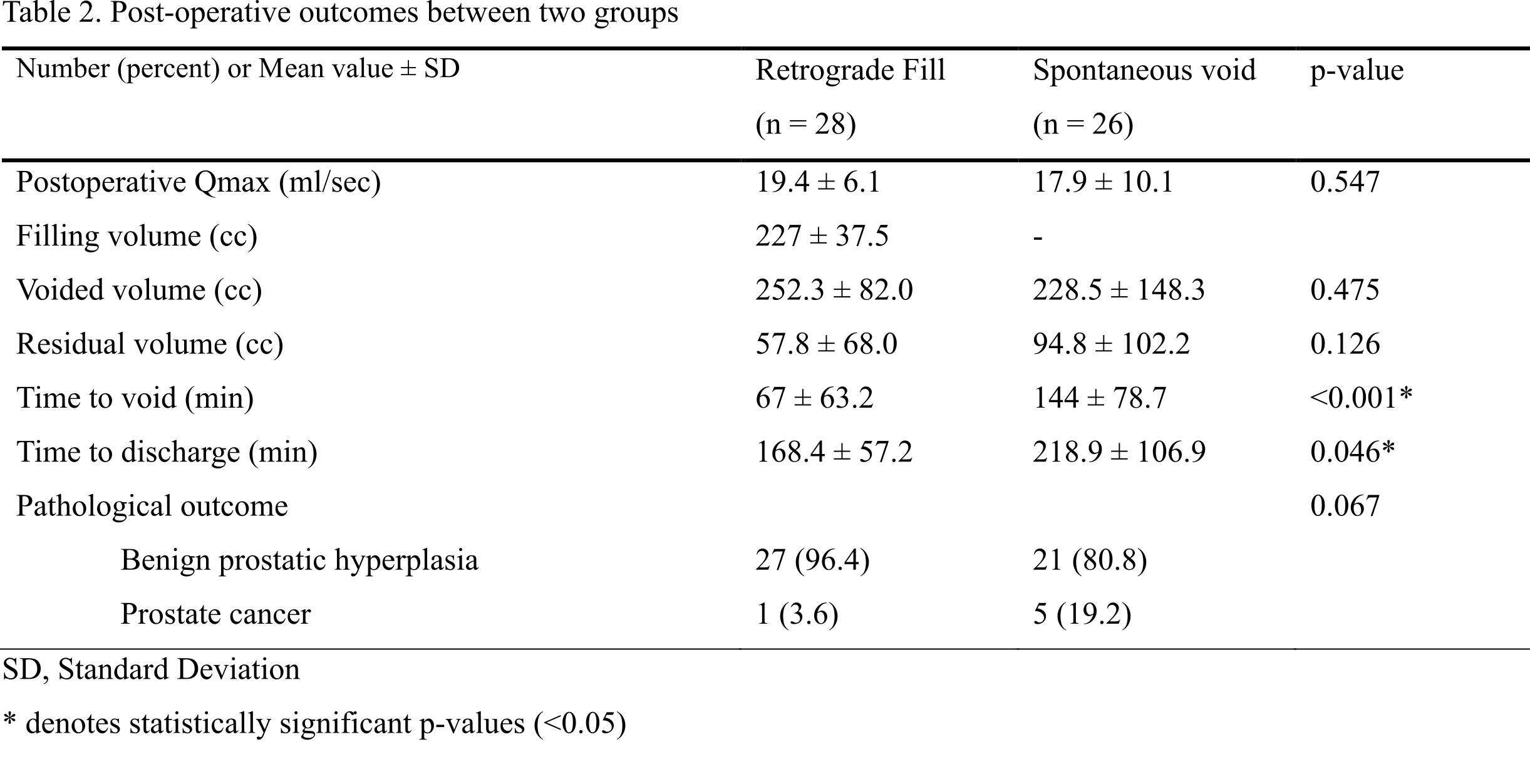
Introduction: Awaiting initial trial without catheter for evaluation for adequacy of discharge can be a time and resource consuming process in both inpatient and outpatient settings, and retrograde bladder filling with normal saline or sterile water is often attempted to expedite the process. However, previous randomized clinical trials have produced statistically insignificant results, with limited literature on men with BPH or patients undergoing TURP. This study intends to compare and evaluate outcomes in patients undergoing removal of catheter after TURP by either retrograde fill (RF) or spontaneous voiding (SV). Methods: Male patients undergoing TURP for BPH from January 2019 to October 2019 were randomized into either RF or SV methods. Perioperative outcomes and complications were assessed, and satisfaction with either technique was assessed with questionnaires for the patient as well as the clinician (nurse or physician) involved in removing the Foley catheter. Time to void and time to discharge was compared to assess facilitation of discharge. Results: Total 54 patients randomized into two groups were included in final analysis, with 28 men in retrograde filling and 26 in SV. No significant differences in baseline characteristics including age, prostate volume, or perioperative uroflowmetry were observed. RF significantly facilitated time to void (67±63.2 min vs 144 ± 78.7; p=0.001) and time to discharge (168.4±57.2 vs. 218.9±106.9; p=0.046). Immediate postoperative Clavien-Dindo grade=3 complication and reintervention within a 3 month follow-up were comparable in both methods with no significant difference. Overall patient and medical staff satisfaction showed tolerable and similar response by either procedure. Conclusions: RF for catheter removal in urologic inpatient settings is a safe and satisfactory method that can facilitate void and time-to-discharge, decreasing length of unnecessary hospital stay. When feasible, the procedure can be undertaken in routine clinical practice. Larger trials with long-term follow-up are required to further validate our results. SOURCE OF Funding: None