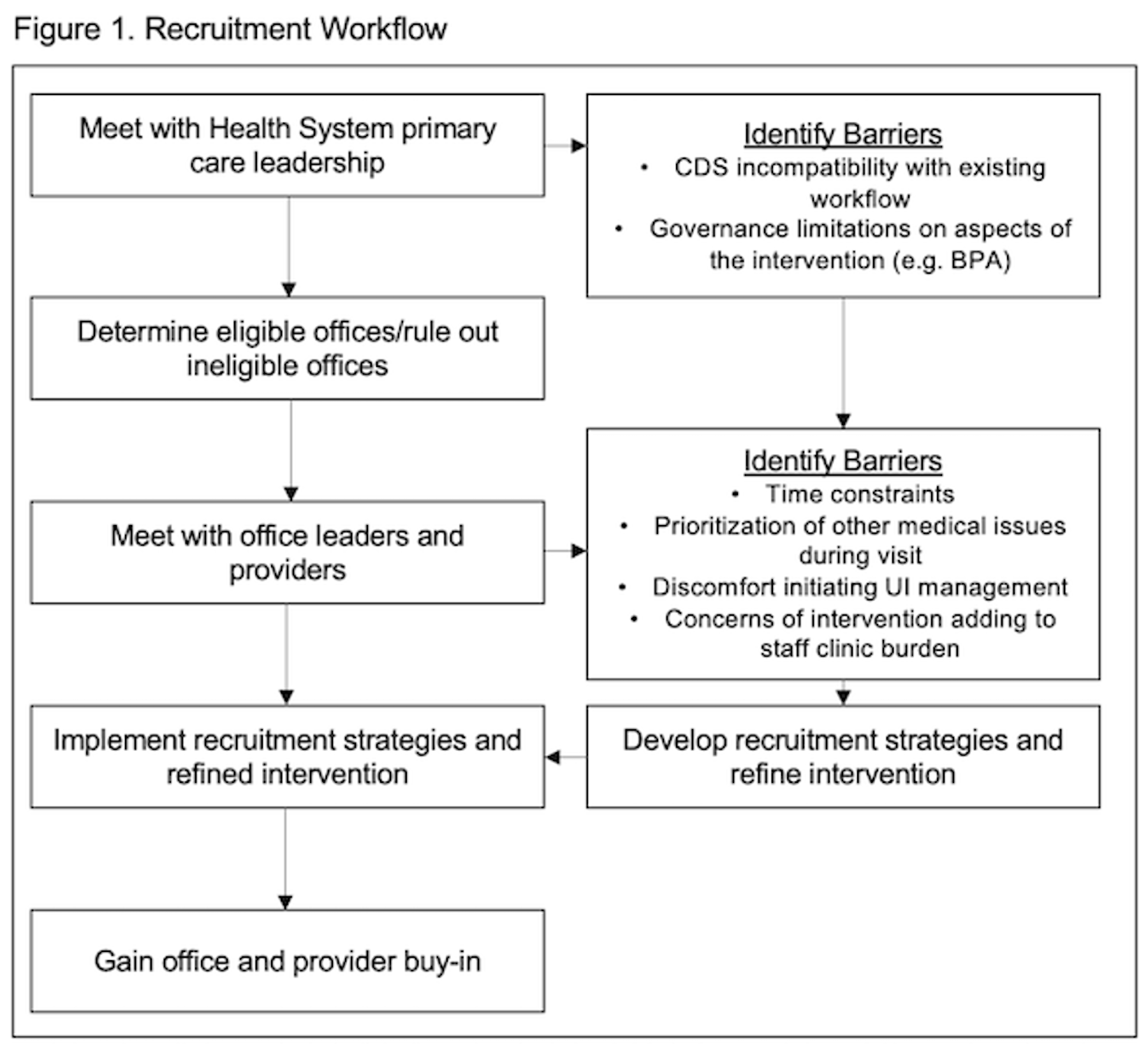
Introduction: Low rates of recruitment pose significant barriers to the success of trials and can lead to incomplete trials, insufficient power, and inconclusive results. There is limited literature on strategies to recruit providers for studies evaluating practice-based interventions. We sought to identify barriers to recruitment of primary care (PC) providers and improve enrollment for an office-based urinary incontinence (UI) intervention. Methods: The intervention consists of a combination of academic detailing, clinical decision support, co-management with a dedicated advanced practice provider, and implementation of an e-consult referral service, in which referrals lacking appropriate primary UI care are returned. The recruitment goal of the study is to enroll 225 providers, across 60 primary care offices within 4 Southern California medical groups. Recruitment barriers were identified based on clinician and PC leadership feedback. Results: Between February and October 2022, meetings were held between study investigators and PC leadership at each site to identify eligible PC offices. Offices were excluded for intrinsic and extrinsic factors incompatible with the study design including lack of integration with the electronic medical record environment and transitioning clinical leadership. Eligible offices were contacted and asked to participate. Providers cited time constraints, prioritization of other medical issues during the visit, discomfort providing UI counsel or initiating UI medications, and concerns of increased clinic burden as barriers to enrollment. Strategies that improved provider buy-in included PC leadership emphasizing the implementation of Medicare 5 Star metrics for UI as the future of standard clinical care, investigators integrating provider feedback into the design of the intervention, and emphasizing study interventions that could reduce clinical burden. With these strategies, 61 offices across the 4 sites agreed to participate. Conclusions: Lower than expected recruitment rates threaten the success of a clinical trial. Early identification of potential barriers and involvement of PC leadership in intervention design and office selection can improve recruitment rates and lead to high-quality practice-based intervention trials. SOURCE OF Funding: Funded by the Agency of Healthcare Research and Quality. Project 1U18HS028740.

.jpg "Isabella Dolendo, BS (she/her/hers) photo")