MP56-19: Machine Learning Framework-Based Prognostic Classifier For Predicting Recurrence-Free Survival In Patients Undergoing Radical Cystectomy For Urothelial Bladder Cancer
Associate Professor University of Southern California
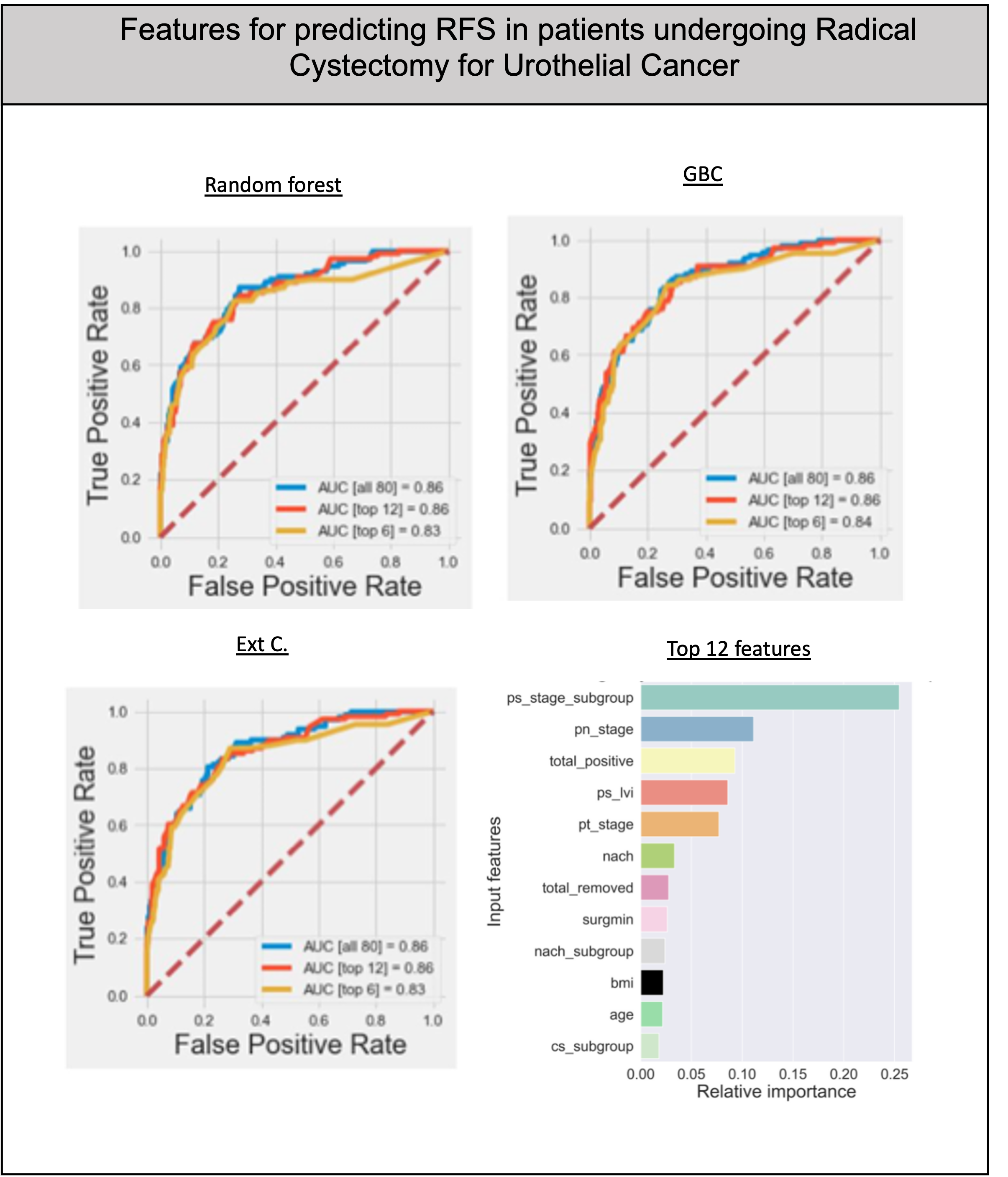
Introduction: To assess the potential value of using machine learning (ML) approaches to derive risk prediction models for urothelial bladder cancer (BCa) recurrence at 1, 3, and 5 years after radical cystectomy (RC). Methods: We used our established, IRB-approved (HS-01B014), longitudinally maintained, RC database of consecutive BCa primary surgical cases containing prospectively collected, detailed clinical, radiologic, and pathologic elements (years 1975-2016) to select patients with urothelial BCa. We included on only those with urothelial carcinoma histology treated with intent to cure. We excluded non-BCa primary patients undergoing RC for other pelvic malignancies. We further sub-divided the data into three groups with known recurrence-free survival (RFS) status at the 1-, 3-, and 5-year marks from the time of RC. The data was split into training (60%), validation (20%) and testing sets (20%). Separate classifiers for predicting 1-, 3-, and 5-year RFS were constructed using ML methods that included support vector machines, multilayer perceptrons, random forests (RFC), gradient boosting (GBC), extra trees (ExTC), and AdaBoost. Results: Our analysis included 2152 patients with uBCa in our dataset, of which we have a minimum of 1 year of continuous data. The performance of the three top models in predicting 1-, 3-, and 5-year RFS is 0.882, 0.830, and 0.876 for RFC, 0.884, 0.849, and 0.874 for ExtC, and 0878, 0.828, and 0.872 for GBC, respectively. The AUC for the set of the top 12 features showed an accuracy between 0.827(95%CI 0.826-0.827) to 0.879 (95%CI 0.877-0.880). Conclusions: We report a ML-based framework, which incorporates disease and patient factors to predict 1, 3, and 5 years of RFS in patients undergoing RC for BCa with higher accuracy than the leading nomograms. SOURCE OF Funding: none