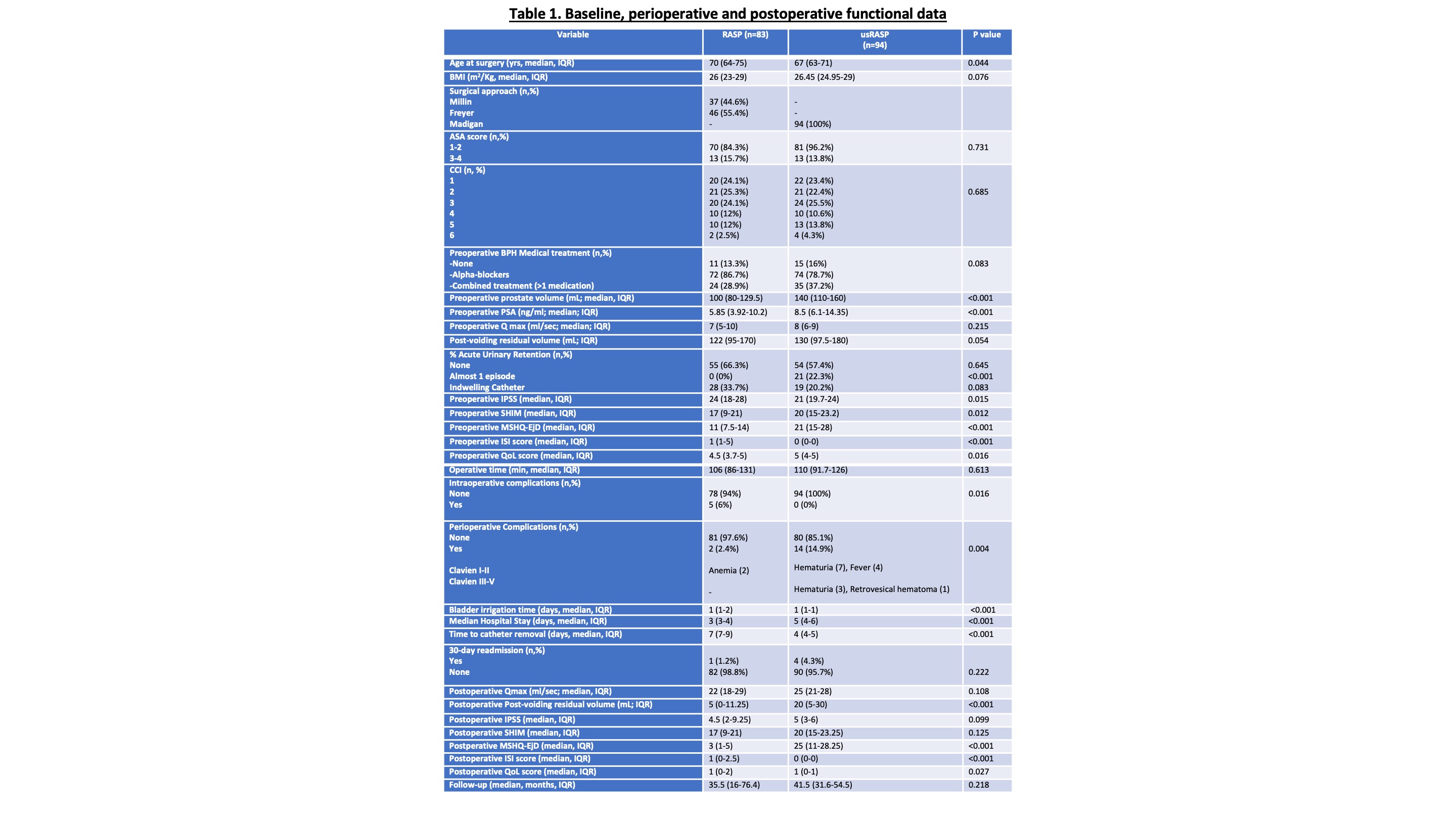
Introduction: Urethral-sparing-RASP (usRASP) recently emerged as an innovative option for preserving antegrade ejaculation. To date, there is no clear recommendation for considering a robotic procedure as a standard treatment for large prostate glands. We aimed to compare perioperative and functional outcomes of usRASP vs standard RASP techniques on a large, multicentric dataset. Methods: Two institutional BPH datasets (n=295) were matched and queried for “RASP” (Group A; n=83) and “usRASP” (Group B; n=94). Baseline, perioperative and functional data were compared between groups. Differences between continuous variables were assessed with Kruskal-Wallis test, while Pearson’s ?2 test was used for categorical data. Results: Baseline and perioperative data were reported in Table 1. Compared to group B, patients treated with standard RASP were older (p=0.044), had lower preoperative PSA median values, prostate volume and episodes of urinary retention (all p<0.001), higher baseline median International Prostatic Symptoms Score (IPSS, p=0.015), lower median Sexual Health Invetory for Men (SHIM, p=0.012) and Insomnia Severity Index scores (ISI, p<0.001). In the group B, patients showed significantly higher median Male Sexual Health Questionnaire-Ejaculatory Dysfunction (MSHQ-EjD, p<0.001) and Quality fo Life scores (QoL, p=0.016). All other variables were comparable between groups (all p>0.05). With regard to perioperative outcomes, patients treated with usRASP revealed higher perioperative complications rates (Clavien>2, p=0.004), decreased median bladder irrigation time, longer median hospital stay and lower time to catheter removal (all p<0.001, Table 1). At a median follow-up of 41.5 months (IQR 31.6-54.5), usRASP showed higher post-operative post-void residual (PVR, 20 vs 5 ml) even if not clinically meaningful, significantly increased median MSHQ-EjD, lower ISI scores (all p<0.001), and increased QOL scores (p=0.027). Conclusions: Compared to standard RASP, usRASP showed non-inferior symptom relief, improved functional and sexual outcomes at long-term follow-up. However, to avoid unnecessary perioperative morbidity, current indications to usRASP remain limited to patients with large adenomas, sexually active and motivated to preserve ejaculatory function. SOURCE OF Funding: None