Session: PD29: Bladder Cancer: Epidemiology & Evaluation II
PD29-09: Comparison of Survival Outcomes Among Patients with Positive Soft Tissue Margins Versus Positive Non-Soft Tissue Margins Alone Following Radical Cystectomy for Muscle Invasive Bladder Cancer
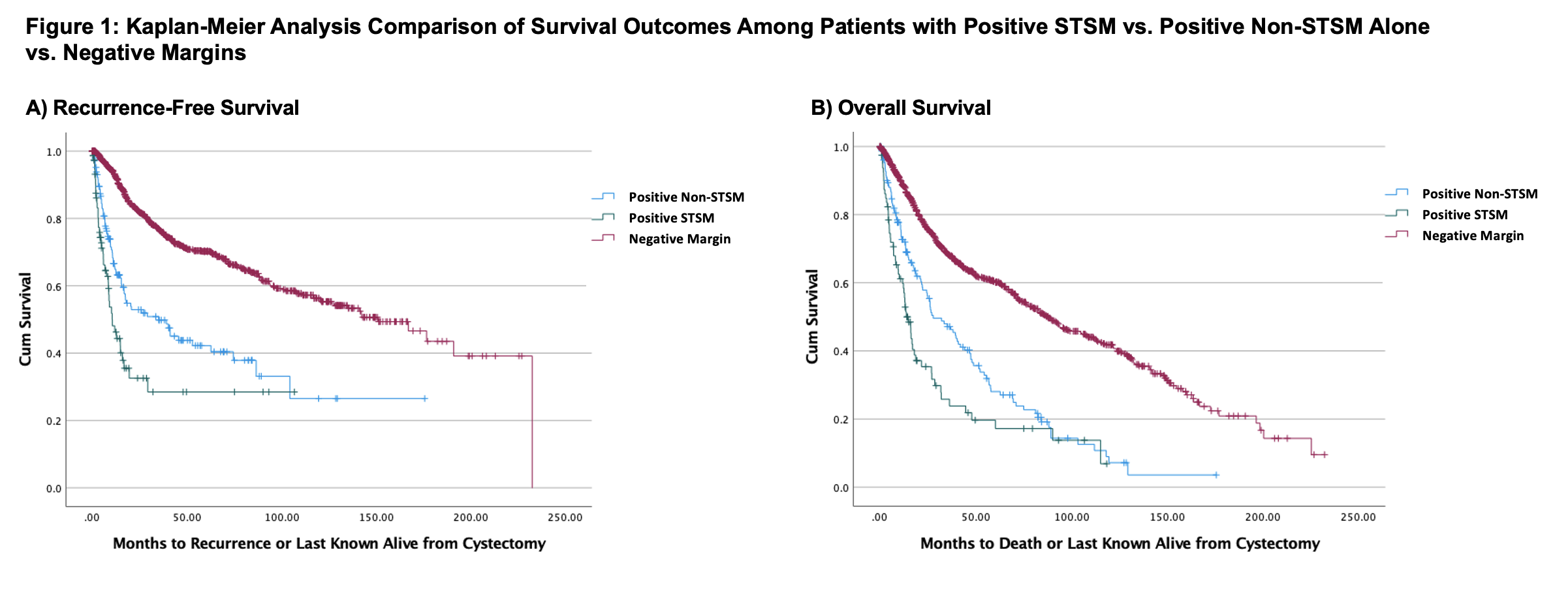
Introduction: Radical cystectomy (RC) is a mainstay treatment for patients with muscle-invasive bladder cancer. While positive soft tissue surgical margins (STSM) portend worse outcomes compared to negative margins, outcomes from positive STSM vs positive non-STSM alone remain understudied. We compare outcomes among patients with positive STSM, positive non-STSM alone, and negative margins following RC. Methods: A retrospective cohort study was conducted using a single-institution RC registry from 2000-2018. Inclusion criteria included age >18, histologically confirmed urothelial carcinoma, RC with curative intent, and available pathology report. We defined 3 patient groups: 1) positive STSM (adjacent muscle or pelvic organs) +/- positive non-STSM, 2) positive non-STSM (urethra or ureter) alone, 3) negative margins. Kaplan-Meier (KM) analysis with log-rank test was used to compare recurrence-free survival (RFS) and overall survival (OS). Results: A total of 236 patients with positive margins and 1,138 patients with negative margins after RC were included. Of those with positive margins, 83 (35.2%) had positive STSM and 153 (64.9%) had positive non-STSM alone. There was no difference in age, adjuvant chemotherapy use, pN+ rate between those with positive STSM compared to non-STSM. There was significantly higher variant histology (25.9% vs 8.4%, p<0.001) as well as NAC utilization (43.2% vs 25.2%, p=0.009) in positive STSM compared to non-STSM. Patients with positive STSMs demonstrated significantly worse median RFS (10.5 months vs 35.1 months, p=0.009) and OS (13.7 vs 27.8 months, p=0.013) compared to those with positive non-STSMs alone. Patients with positive non-STSM alone had significantly worse median RFS (35.1 vs 150.8 months, p<0.001) and OS (27.8 vs 87.7 months, p<0.001) compared to those with negative margins. KM analysis demonstrated distinct RFS and OS outcomes between the 3 groups (Figure 1). Conclusions: Positive STSM were associated with worse RFS and OS compared to positive non-STSM however positive non-STSM alone represents a distinct clinical entity from those with negative margins, and these data can inform patient counseling. This study was limited by differential rates of variant histology and NAC use. SOURCE OF Funding: NA