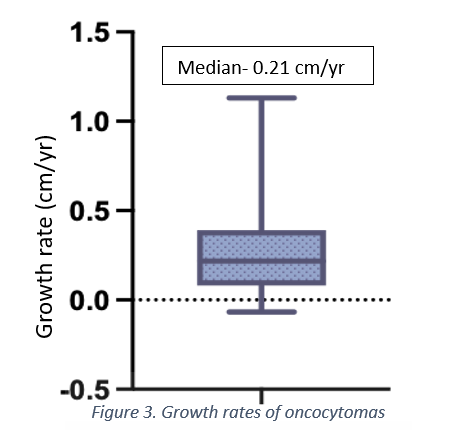
Introduction: Renal oncocytomas are benign neoplasms, accounting for 3-7% of renal tumors. A select number of patients can present with bilateral and/or multifocal oncocytomas and negative germline testing. There is limited data on the clinical course of this subset of patients and optimum treatment strategy remains unclear. This study seeks to evaluate the renal functional and oncological outcomes in patients with bilateral multifocal renal oncocytomas. Methods: We retrospectively reviewed a cohort of 64 patients with histopathologically confirmed bilateral multifocal renal oncocytomas with negative genetic testing who underwent active surveillance, partial or radical nephrectomy at our institution. Demographics, oncologic outcomes, renal function change and tumor growth rate using 2-dimensional measurements on cross-sectional imaging were assessed. Renal function outcomes were assessed using serum creatinine levels within and between two groups (based on management strategy) with Wilcoxon signed ranked test and Mann-Whitney test respectively. Results: A total of 64 patients (51 males, 13 females) with a median age of diagnosis of 64 years and mean follow-up of 5.7 years were studied. 19 patients underwent only active surveillance, and 45 patients underwent at least one surgical intervention during the study period. Median age of first procedure was 61.5 years. Interventions included 2 renal ablation, 52 partial, and 13 radical nephrectomies. The median growth rate was 0.21 cm/year (0.16-0.27 cm/year), with a new tumor diagnosed on imaging every five years. The median change in serum creatinine was 0.13 mg/dL on active surveillance and 0.12 mg/dL after surgery (p = 0.6). No metastases were noted in this cohort throughout the study period. The median age of death was 82.4 years. Conclusions: Bilateral multifocal renal oncocytomas with negative genetic workup are benign tumors with an indolent course and are seen primarily in 6th decade of life. Considering a minimal difference in functional outcomes between active surveillance and surgical management, surgeons may consider the additional clinical characteristics of patients to design the individual management plan. SOURCE OF Funding: This research was supported, in part, by the Intramural Research Program of the National Institutes of Health Clinical Center.