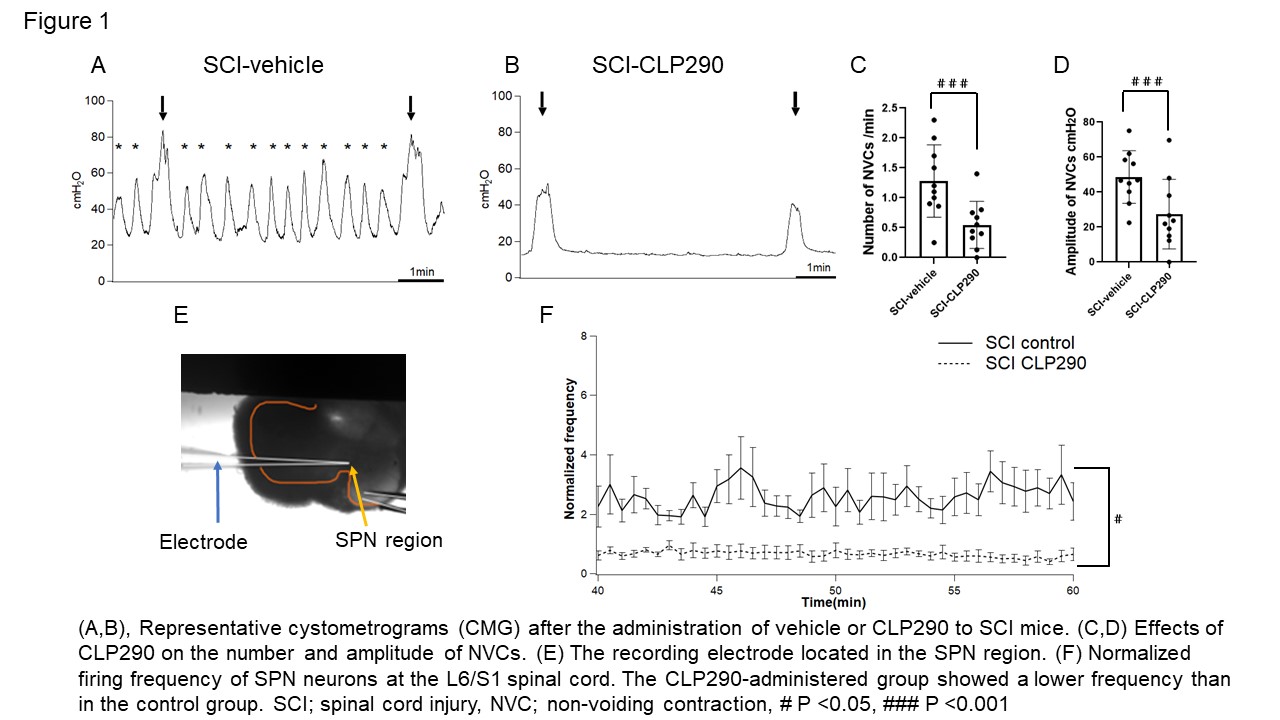
Introduction: GABA generally exerts inhibitory effects in the central nervous system, including the spinal cord. However, it may also act as an excitatory transmitter under pathological conditions, such as injury. This paradoxical signaling of GABA is dependent on the intracellular Cl- concentration in neurons. K+-Cl- co-transporter 2 (KCC2) maintains a low intracellular Cl- concentration by pumping K+ and Cl- ions out of the cell. We aimed to clarify whether the down regulation of KCC2 in the sacral parasympathetic nucleus (SPN) of the lumbosacral spinal cord, from which the efferent pathway innervating the bladder originates, causes cellular hyperexcitability and triggers detrusor overactivity (DO) in spinal cord injury (SCI). Methods: SCI was produced by the Th8-9 spinal cord transection in female C57BL/6 mice. We randomly divided mice into four groups: a spinal cord intact (SI)-vehicle, SI-CLP290, SCI-vehicle, and SCI-CLP290 groups. At 4 weeks after SCI, CLP290, a KCC2 activator was administered, and cystometry was performed. Thereafter, neuronal activity with c-fos staining and KCC expression in the cholinergic preganglionic parasympathetic neurons in the SPN were examined using immunohistochemistry. Firing properties of neurons in the SPN region were evaluated by extracellular recordings in spinal cord slice preparations. Results: DO evident as non-voiding contractions (NVC) was significantly reduced by CLP290 treatment in SCI mice (Fig. 1 A-D). The number of c-fos-positive cells and co-expression of c-fos in choline acetyltransferase (ChAT)-positive cells were decreased in the SPN region of SCI-CLP290 group vs. SCI-vehicle group. KCC2 immunoreactivity was present on the cell membrane of SPN neurons, and the normalized fluorescence intensity of KCC2 in ChAT-positive SPN neurons was decreased in SCI-vehicle group, vs. SI-vehicle group, but recovered in SCI-CLP290 group. Extracellular recordings showed that CLP290 suppressed the high frequency firing activity of SPN neurons in SCI mice (Fig. 1E-F). Conclusions: This study is the first report to suggest that activation of KCC2 chloride ion transporter may be a therapeutic modality for the treatment of SCI-induced DO by targeting bladder efferent pathways. SOURCE OF Funding: This work supported by a Grant-in-Aid for Scientific Research from the Japan Society for the Promotion of Science and a HUSM Grant-in-Aid.