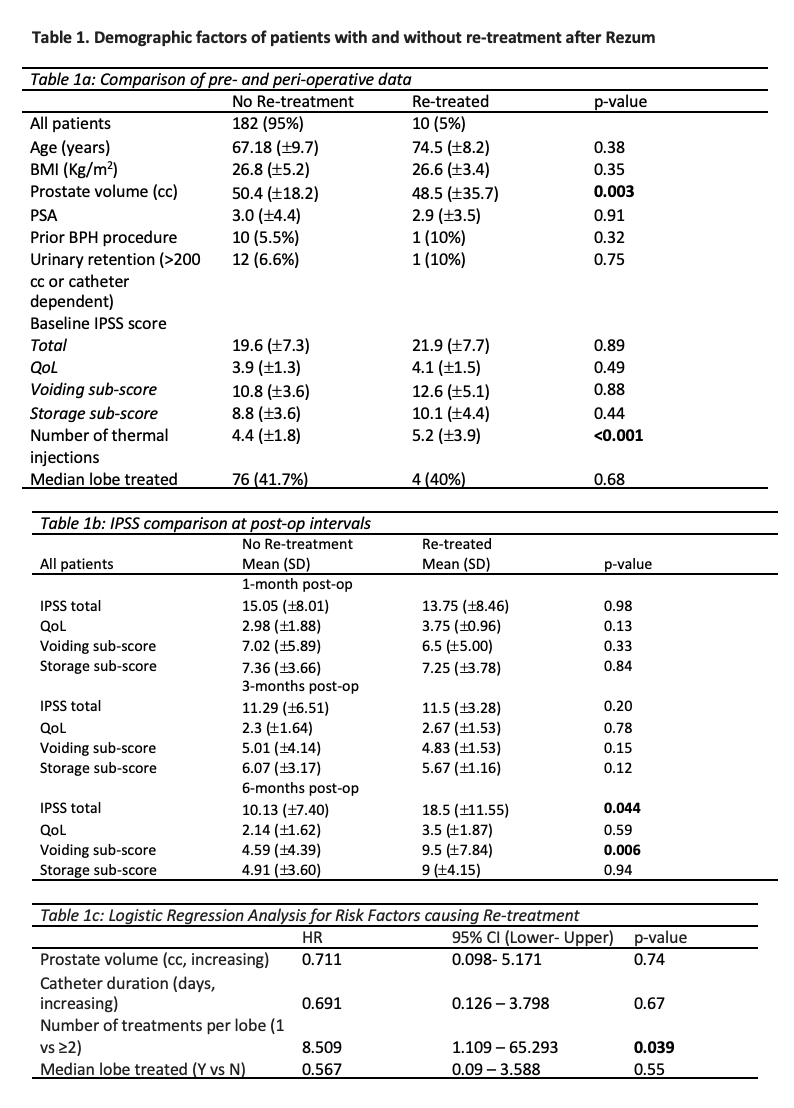
Introduction: Water vapor thermal therapy (Rezum, Boston Scientific, Marlborough, MA, USA) has become increasingly used as a minimally invasive surgical treatment for LUTS due to benign prostatic hyperplasia (BPH) with a low re-treatment rate. We sought to identify predictors of re-treatment or symptom recurrence. Methods: We retrospectively reviewed patients treated with water vapor thermal therapy at a single institution from August 2017 to February 2022. Patient demographics, pre- and peri-operative data, and international prostate symptom scores (IPSS) were evaluated. Patients who underwent a second BPH procedure (“re-treatment”) for persistent or recurrent LUTS within 2 years of original treatment were compared to the remainder of the cohort who did not undergo re-treatment. Multivariate analysis (MVA) was used to assess for predictors of re-treatment. Results: Data from 192 consecutive patients undergoing water vapor thermal therapy were collected and analyzed. 10 (5%) patients were re-treated. Men in the re-treatment cohort had smaller prostate volumes (48.5 vs 50.4, p=0.003) and received a greater number of water vapor injections (5 vs 4, p<0.001). Baseline IPSS score or median lobe treatment was not associated with re-treatment (Table 1a). At 6-month follow-up, total IPSS (10.13 vs 18.5, p=0.044) and IPSS voiding sub-scores (4.59 vs 9.5, p=0.006) were significantly worse in the re-treated group (Table 1b). On MVA, =3 total treatments (>1 per lobe) during an initial Rezum procedure were independently associated with increased risk of re-treatment (HR 8.51, p= 0.039). Increasing prostate volume, catheter duration, and treatment of the median lobe were not significantly associated with an increased risk of re-treatment in these patients (Table 1c). Conclusions: We found that water vapor thermal therapy has a good performance with a low re-treatment rate, consistent with larger published studies. Men who did require re-treatment of their LUTS from BPH tended to receive more vapor injections and showed significant worsening of voiding symptom scores around 6 months post-operatively. Decreasing the number of vapor injections when possible may help further reduce treatment failure rates. SOURCE OF Funding: None