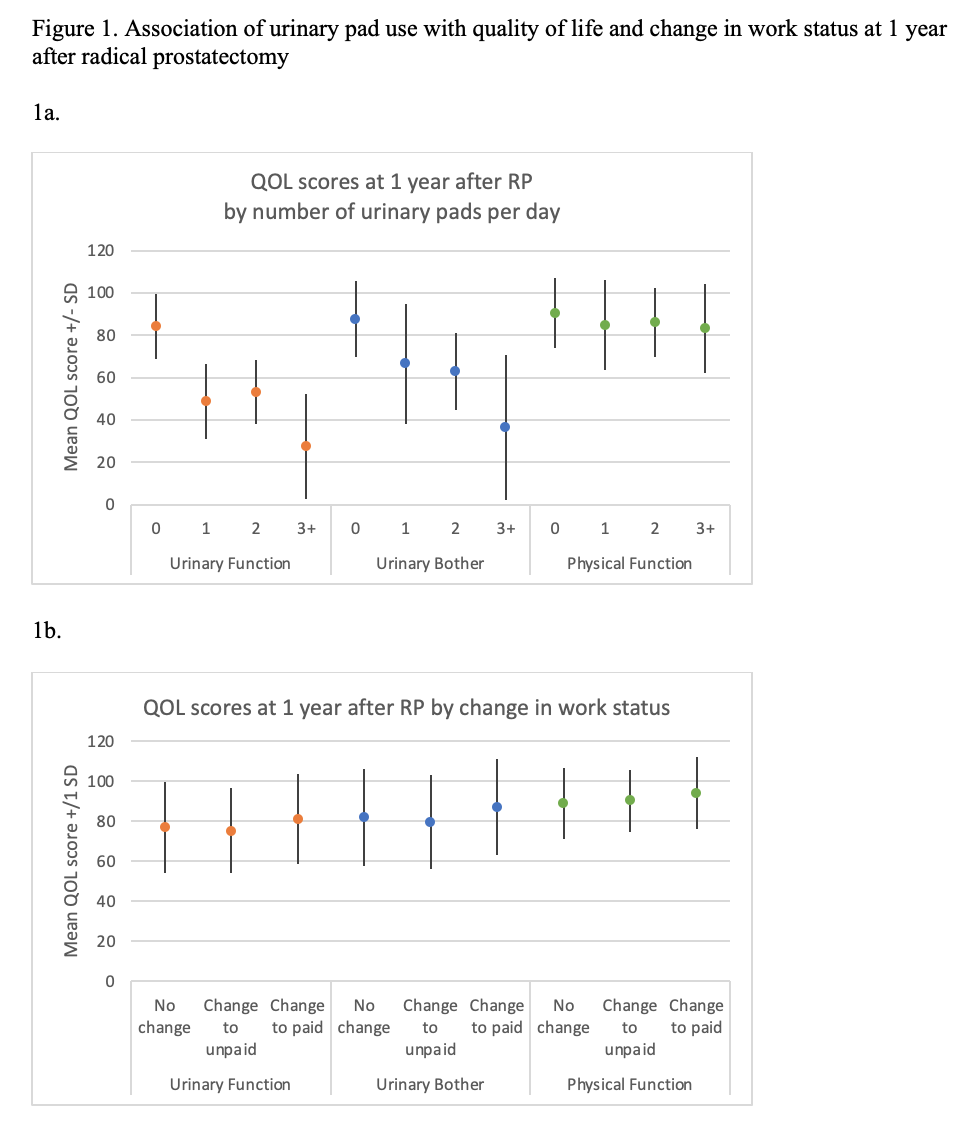
Introduction: Stress urinary incontinence (SUI) after radical prostatectomy (RP) can impact quality of life, work status and need for additional surgery. We aim to characterize the cumulative incidence of SUI procedures and report changes in urinary function (UF) and bother (UB), physical function (PF) and work status 1 year after RP. Methods: Men with prostate cancer (PCa) treated by primary RP (1998-2016) were selected from CaPSURE. SUI was defined as use of any urinary pads per day (ppd) 1 year after RP. SUI procedure was tracked by CPT codes for urinary sling and artificial sphincter. Patients reported work status (full-time paid, part-time paid, unpaid), UF and UB scores (0-100) using UCLA PCa Index and PF using SF36 Index. Associations of incontinence with changes in UF, UB and PF and work status were assessed (ANOVA). Lifetable estimates and Cox proportional hazards regression were used to evaluate risk of undergoing a SUI procedure. Results: Of 2,989 men treated with RP, 664 (22%) reported SUI at 1 year. Mean age was 61 years. More men with SUI had =GG2, intermediate to high-risk disease and non-nerve sparing surgery (all p<0.01). Cumulative incidence of SUI procedures was 1.4% at 10 years after RP (0 ppd: 0,3%; 3+ ppd: 12.9%) with median time to intervention of 48 months (IQR 27, 84). SUI procedures comprised of 53% AUS, 24% slings, 9% both and 15% unspecified. Older age (HR 2.68 per 10 years, 95% CI 1.41-5.08, p<0.01) and number of ppd at 1 year (HR 3.20, 95% CI 2.27-4.50, p<0.01) were associated with higher risk of undergoing SUI procedure. UF scores declined significantly from 94 at baseline to 77 at 1 year after RP, while UB and PF remained stable. After RP, UF, UB and PF were inversely associated with increasing number of ppd from 0 to 3+ (all p<0.01). (Figure 1a) Incontinence status (SUI 15% vs no SUI 14%) was not associated with change from paid (FT or PT) to unpaid work at 1 year. QOL scores were not associated with work status. (Figure 1b). Conclusions: SUI at 1 year after RP may occur in up to 22% of patients; however, 10-year rate of SUI procedure was low at 1.4% with median time to intervention of 48 months. Incontinence affected urinary QOL but did not significantly impact work status. This information suggests that men with SUI after RP may continue to work and go under-treated despite impact on quality of life. SOURCE OF Funding: UCSF Goldberg-Benioff Program in Translational Cancer Biology