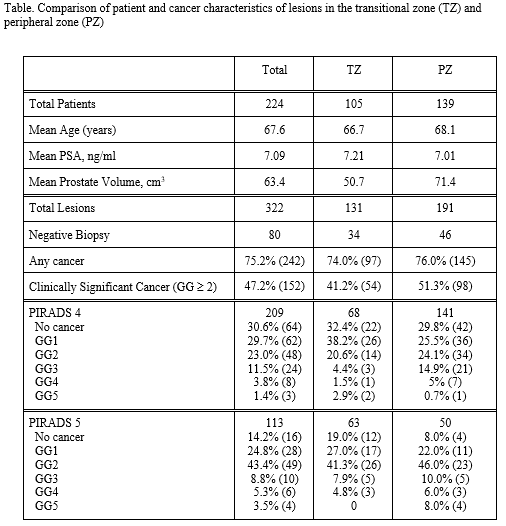
Introduction: There is limited data comparing prostate cancer (PC) detection rates in lesions identified within the peripheral zone (PZ) and transitional zone (TZ) on prostate MRI (pMRI). We compared the diagnostic performance of PIRADSv2 for detecting clinically significant (CS) PC in the PZ and TZ. Methods: Data were queried from the Michigan Urological Surgery Improvement Collaborative (MUSIC) and Spectrum Health EMR to identify patients undergoing MRI assessed using PIRADS v2 by Advanced Radiology Services physicians between June 2016 and September 2022. All patients identified as having one or more PIRADS 4 or 5 lesions were included if they underwent targeted biopsy within 12 months of the MRI. The primary outcome was CSPC defined as GG2 or greater in biopsy of the targeted lesion. Results: A total of 322 lesions in 224 patients were identified, with mean age 67 years, mean PSA 7.1 ng/ml, and mean prostate volume 63.4 cm3. Overall detection of PC was 75.2%, CSPC was 47.2%, and predominant pattern 4-5 (GG3-GG5) was 47.2%. 131 lesions were in the TZ and 191 in the PZ. CSPC was detected in 41.2% of TZ lesions and 51.3% of PZ lesions (p=0.075). CSPC detection was significantly higher for PI-RADS 4 lesions in the PZ compared to TZ (44.7% vs. 29.4%, p=0.034) and trended towards significance in PI-RADS 5 lesions (70.0% vs. 54.0%, p=0.0823). For GG3-GG5 PC, there was also a significant difference seen with PI-RADS 4 (8.8% vs. 20.6%, p=0.033) and a trend with PI-RADS 5 lesions (12.7% vs. 24.0%, p=0.117). Conclusions: Overall detection of PC was consistent with prior literature for PI-RADS 4 and 5 lesions. Lesions in the TZ were more likely to be benign or low-grade PC. This is important information for clinicians managing patients with TZ lesions and may suggest re-consideration of the precise features leading to PI-RADS assignments in the TZ in subsequent revisions. SOURCE OF Funding: The corresponding author would like to thank the Betz Family Endowment for Cancer Research for their continued support. Funding was provided in part by the Spectrum Health Foundation. Funding was provided in part by the Value Partnerships program at Blue Cross Blue Shield of Michigan.