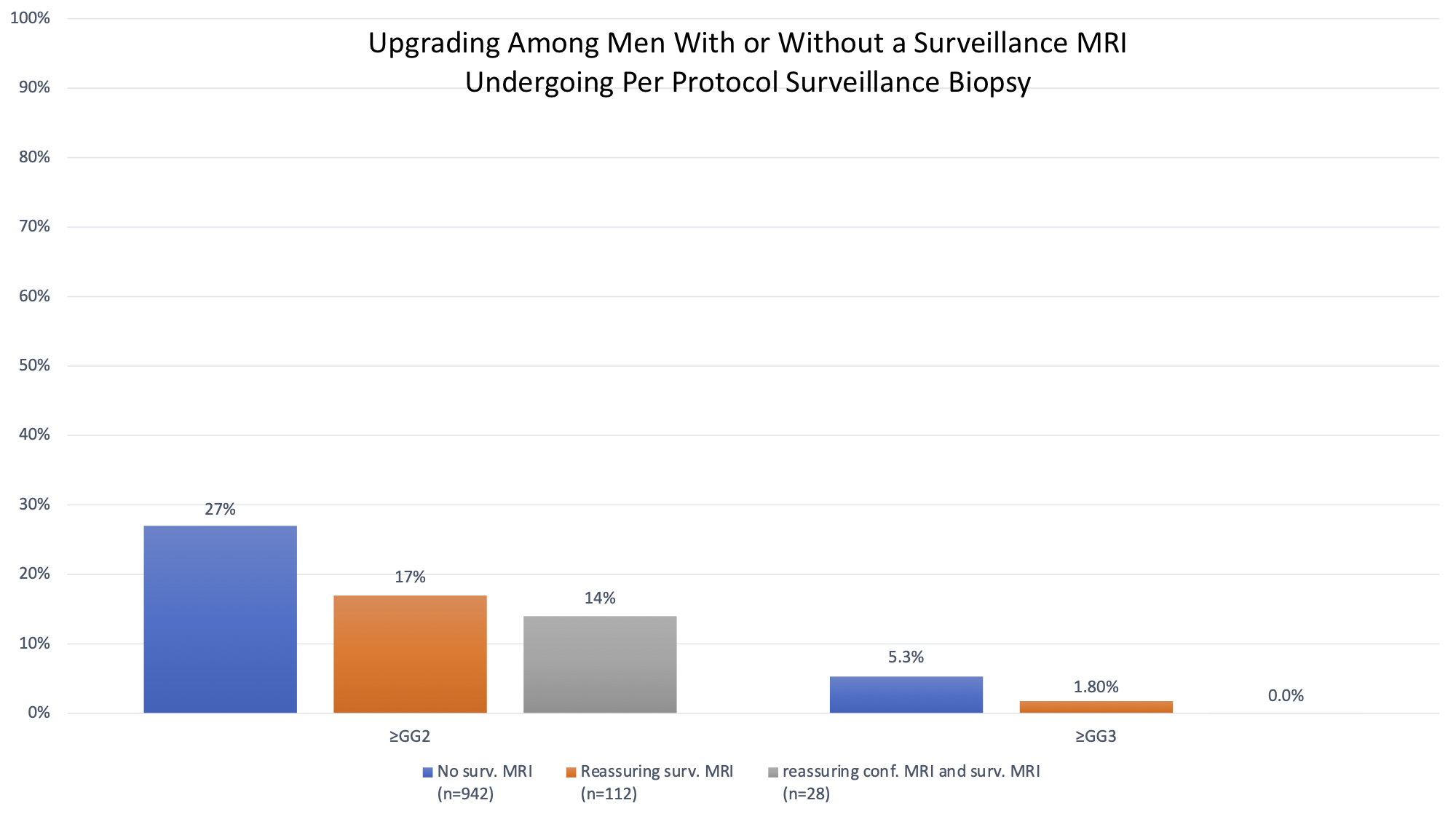
Introduction: Most prostate cancer (PC) active surveillance (AS) protocols recommend “per protocol” surveillance biopsy (PPSBx) every 1-3 years, even if clinical and imaging parameters remained stable. Herein, we compared the incidence of upgrading on biopsies that met criteria for “for cause” surveillance biopsy (FCSBx) vs PPSBx. Methods: We retrospectively reviewed men with GG1 PC on AS in the Michigan Urological Surgical Improvement Collaborative (MUSIC) registry. Prostate biopsies obtained one year after diagnosis were classified as either PPSBx or FCSBx. Biopsies were retrospectively deemed as FCSBx if any of these criteria were met: PSA velocity >0.75ng/ mL/year; rise in PSA >3ng from baseline; surveillance MRI (sMRI) with a PIRADS =4; change in DRE. Biopsies were classified as PPSBx if none of these criteria were met. MRI obtained within 1 year of diagnosis was considered a confirmatory MRI (cMRI), not sMRI. The primary outcome was upgrading to =GG2 or =GG3 on surveillance biopsy. Secondary objective was to assess for the association of cMRI and sMRI with biopsy upgrading in men undergoing PPSBx. Proportions were compared with the chi-squared test. Results: We identified 1,773 men diagnosed with GG1 PC in MUSIC from 2016 to 2020 that underwent a surveillance biopsy, of which 41% and 59% met criteria for FCSBx and PPSBx, respectively. Men meeting criteria for FCSBx had more upgrading to =GG2 (45%) and =GG3 (12%) compared to those meeting criteria for PPSBx (26% and 4.9%, respectively, p<0.001 and p<0.001). Men who had PIRADS 1-3 on cMRI or sMRI undergoing PPSBx had even less upgrading to =GG2 (17% and 17%, respectively) and =GG3 (2.9% and 1.8%, respectively). In the unique scenario in which men had both a cMRI and sMRI with PIRADS 1-3 (n=28), only 14% were upgraded to =GG2 and no patients were upgraded to =GG3 (Figure 1). Conclusions: Patients undergoing PPSBx had significantly less upgrading compared to those undergoing FCSBx. Due to the low upgrading seen with PPSBx in men with stable clinical parameters, especially men with non-concerning cMRI or sMRIs, patients and their urologists may omit a PPSBx after a detailed shared decision making process. SOURCE OF Funding: funding from Blue Cross Blue Shield of Michigan