Session: MP39: Health Services Research: Value of Care, Cost & Outcomes Measures
MP39-04: The Impact of Medicare Low-Income Subsidy on Access to Treatment, Treatment Choice, and Oncologic Outcomes in Patients with Metastatic Prostate Cancer.
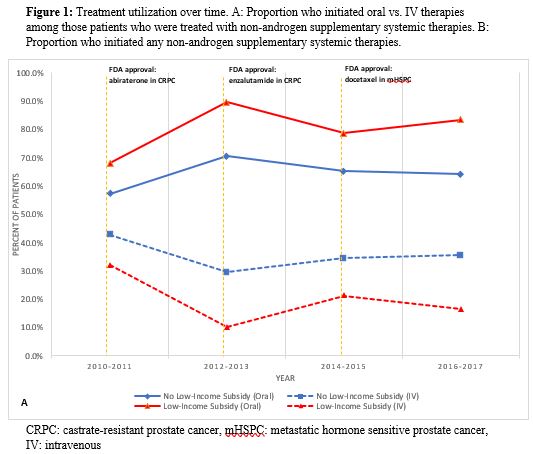
Introduction: Patients eligible for Medicare Part D low-income subsidy (LIS) have lower cost-sharing for both intravenous (IV) and oral cancer therapies. We evaluated associations between LIS and treatment choice, treatment initiation, and overall survival in patients with metastatic prostate cancer. Methods: We identified men aged 66 years and older diagnosed with stage IV prostate cancer between 2010 and 2017 included in the SEER-Medicare linked dataset. Using linear probability models, we evaluated the impact of LIS on type of first supplementary treatment (oral vs. IV) among patients who received non-androgen deprivation supplementary systemic therapy (NASST), and initiation of any NASST. Overall survival was estimated with Kaplan-Meier curves. Results: Of the 5,929 patients included, 1,766 (30%) had LIS. Among patients receiving NASST, oral therapies were the most commonly prescribed first choice at all time points for all patients and especially for the LIS group (Figure 1A). Compared to patients with LIS, a larger proportion of those without LIS received NASST at all time points (Figure 1B). On multivariable analysis, those with LIS were more likely to receive oral as opposed to IV treatments compared to patients without LIS (probability difference: 17.0%, 95%CI 12.1, 22.0). However, patients with LIS were less likely to initiate any NASST (oral or IV) compared to those without LIS (probability difference:7.9%, 95%CI 4.8-11.1). Additionally, patients with LIS experienced worse overall survival than those without LIS (p < 0.001). Conclusions: While having LIS was associated with increased use of more expensive oral therapies in men with metastatic prostate cancer, barriers to accessing these treatments still exist, as patients with LIS were overall less likely to initiate NASST compared to those without LIS. These findings stress the importance of continued efforts to improve healthcare access to low-income individuals. SOURCE OF Funding: None