Session: MP39: Health Services Research: Value of Care, Cost & Outcomes Measures
MP39-17: Sequential intravesical gemcitabine-docetaxel versus bacillus Calmette-Guerin (BCG) in the treatment of non-muscle invasive bladder cancer: a preliminary cost-effectiveness analysis
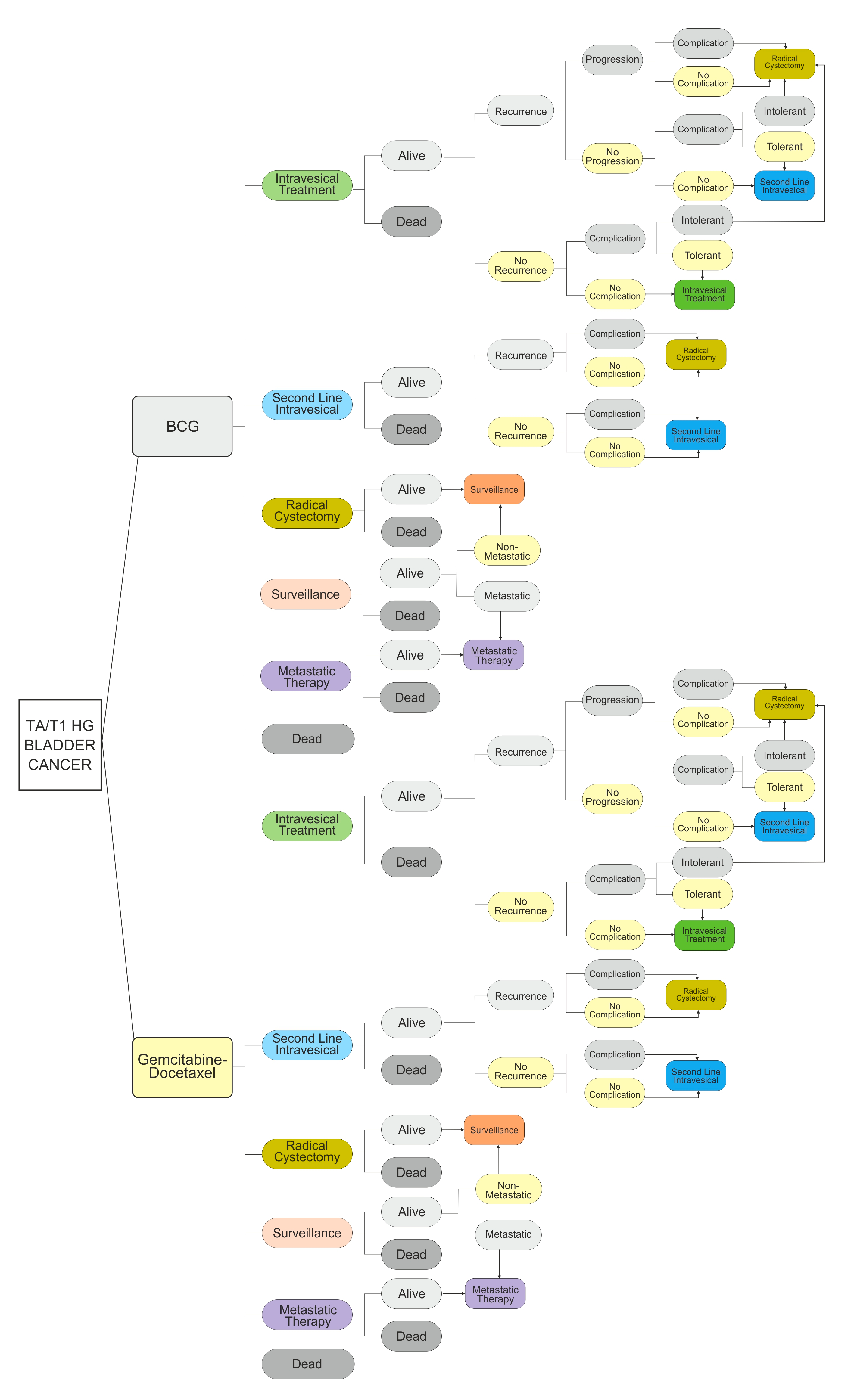
Introduction: Treatment naïve patients with high-risk non-muscle invasive bladder cancer (NMIBC) are treated with bacillus Calmette-Guérin (BCG) therapy as the standard of care. Recently, intravesical sequential gemcitabine-docetaxel in the BCG-naïve setting was shown to be well-tolerated and effective at two years, raising the possibility of a new first line intravesical therapy for high risk NMIBC in over 40 years. The cost effectiveness of this intervention remains unknown; therefore, we designed a cost effectiveness study evaluating BCG versus sequential gemcitabine-docetaxel in patients with high-risk NMIBC. Methods: Using TreeAgePro 2019 (Williamstown, MA) software, we developed a Markov model to evaluate BCG versus gemcitabine-docetaxel from the U.S. Medicare perspective with a 2-year time horizon. Model probabilities and utilities were derived from published literature. Direct costs were obtained from Medicare cost databases. Our primary oucomes were effectiveness (measured in quality adjusted life years (QALYs)), cost and the incremental cost-effectiveness ratio with a willingness to pay threshold of $100,000. Model schematic is depicted in Figure 1. Results: Our results indicate that while both treatments resulted in similar QALYs of 1.76, the mean costs per patient at 2 years were $12,363 and $7,090 for BCG and gemcitabine-docetaxel, respectively. Therefore, the BCG strategy was dominated by the gemcitabine-docetaxel strategy as it was equally effective and less costly. One way sensitivity analyses were completed to evaluate the model’s robustness to changes in the data inputs and throughout the scenarios assessed gemcitabine-docetaxel remained a cost-effective strategy as the BCG strategy continued to be dominated. Conclusions: The findings of this preliminary cost-effectiveness analysis are novel in that they highlight a well tolerated, efficacious drug that is less expensive than the traditional gold standard therapy. In modern medicine, we are more often challenged by agents with marginally increased efficacy but at significantly higher costs; gemcitabine-docetaxel represents a rare entity which is a success for both patients and healthcare systems alike. SOURCE OF Funding: None