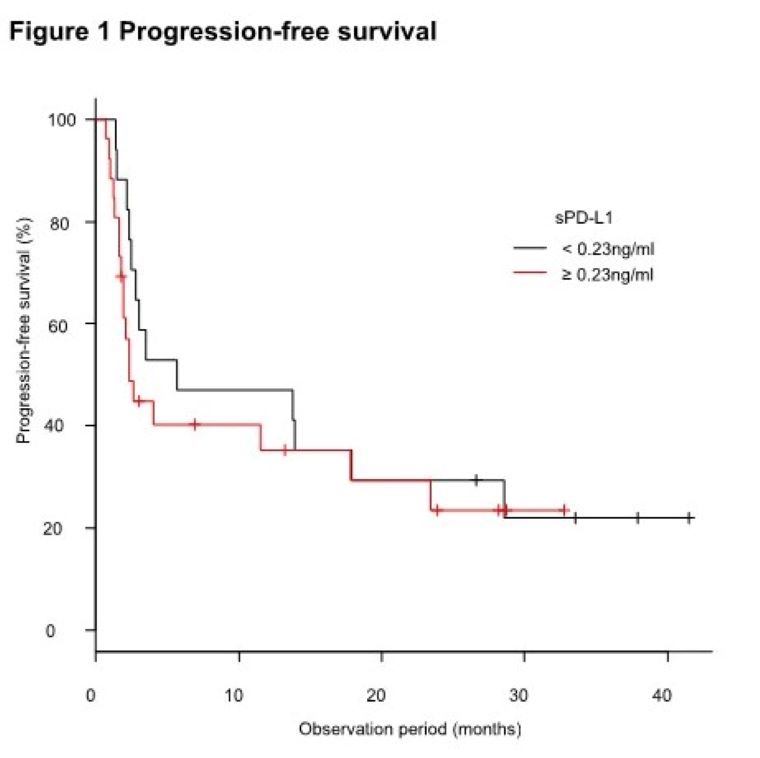
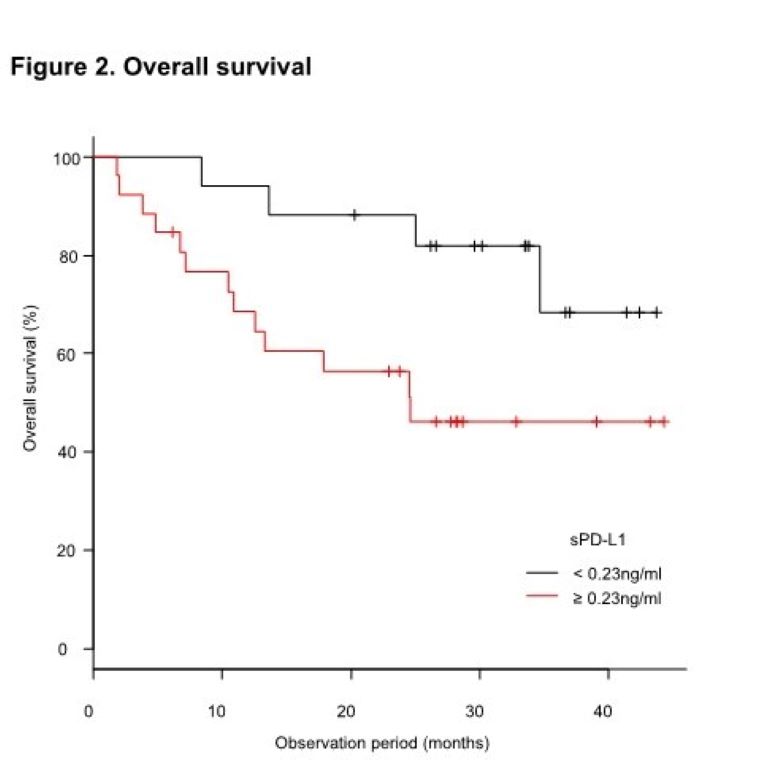
Introduction: Effective treatment options for metastatic renal cell carcinoma (mRCC) have been increasing. Therefore, predictors of treatment response are important. PD-L1 expression in renal cancer has been reported as a predictor of treatment response and prognosis. However, PD-L1 expression by immunohistochemistry is invasive and difficult to assess repeatedly. Recently, it has been shown that soluble PD-L1 (sPD-L1) is useful as a predictor in several tumors. Therefore, we evaluated sPD-L1 in mRCC patients treated with nivolumab and investigated the association between sPD-L1 and treatment response. Methods: This study was a prospective single-arm study. Patients with mRCC treated with nivolumab as second line or later were included. We measured serum sPD-L1 in patients before and during treatment. The patients were classified based on baseline sPD-L1 (sPDL1 =0.23ng/ml vs <0.23ng/ml). We compared outcomes between the two groups. Results: A total of 43 patients with mRCC were included in this study, with 17 (39.5%) low sPD-L1 patients and 26 (60.5%) high sPD-L1 patients. The International Metastatic RCC Database Consortium risk score was significantly poorer in the high sPD-L1 group. The objective response rate was significantly higher (41.2% vs 7.7%) and overall survival significantly longer (p=0.03) in the low group compared with the high group. There were no significant differences in progression-free survival between the two groups. Conclusions: The present study indicated that sPD-L1 might be a predictor of treatment response to nivolumab for mRCC patients. SOURCE OF Funding: This work was supported by Ono Pharmaceutical Co., Ltd. and Bristol-Myers Squibb, Co.