Introduction: Peyronie's Disease (PD) can be surgically challenging, especially in men with indentation deformity. Extratunical grafting (ETG) is a relatively new surgical option that be employed to treat corporal indentation in those without buckling or hinge effect.
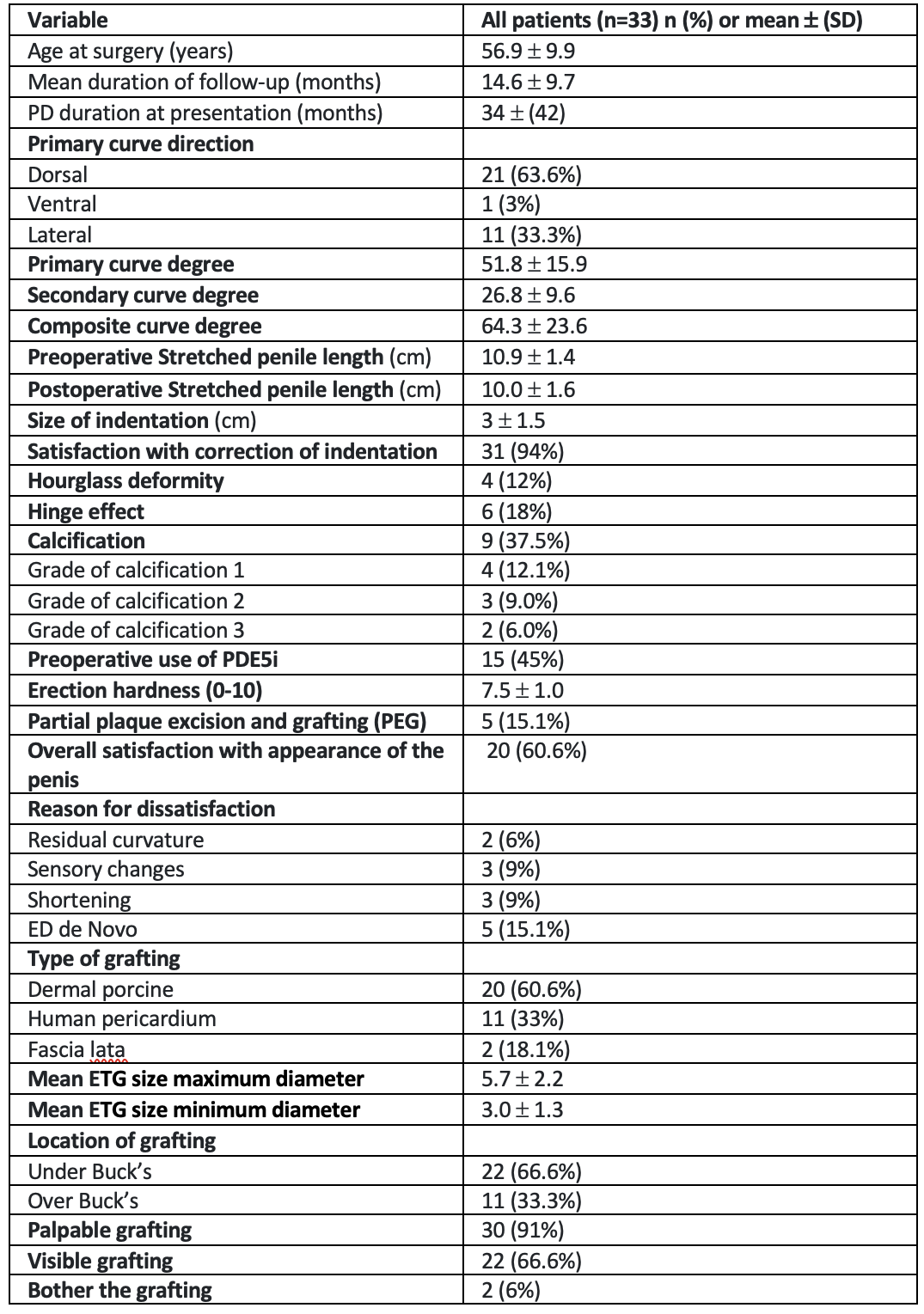
Objective: To report our experience with the ETG procedure, including different grafts or graft location (under or over Buck’s fascia) pre and post-operative patient characteristics, and patient satisfaction. Methods: We performed a retrospective chart review of patients following ETG, collecting data including baseline demographics, prior treatments, pre-operative deformity, erectile function, type of graft, grafting location (under or over Buck’s), patient satisfaction, and clinical outcomes at our tertiary-care referral center. Results: From December 2018 to July 2022, 33 patients presenting with PD underwent an ETG and TAP and/or PEG (partial plaque excision and grafting) for indentation deformity with a mean follow-up of 14.6 months. Overall, patient satisfaction, specifically for the correction of indentation was 94%. Grafting location under or over Buck's fascia showed no statistical difference in patient satisfaction with penile appearance (54.5% and 72.7%, respectively, p>=0.05). Patients undergoing ETG, with PEG had significantly lower satisfaction with their erect appearance than TAP and ETG (0% and 71.4%, respectively, p=0.003). Several different grafts were used, there was no difference in satisfaction between the grafts used. Palpable graft was reported in 30 patients (91%), but only two were bothered by the graft (6%). Statistical analysis showed no difference in patient satisfaction according to the size of the graft or degree of curve correction. Conclusions: ETG has emerged as a less invasive and less risky surgical option than PEG to correct indentation deformities which are not associated with buckling or axial instability. Our initial results demonstrate a high rate of satisfaction with correction of indentation, but multiple factors contributed to lower overall satisfaction with appearance of the penis including loss of length (9%), residual curvature (6%), sensory changes (9%), and erectile dysfunction (15.1%). Further studies are needed to determine the optimum approach. SOURCE OF Funding: None.