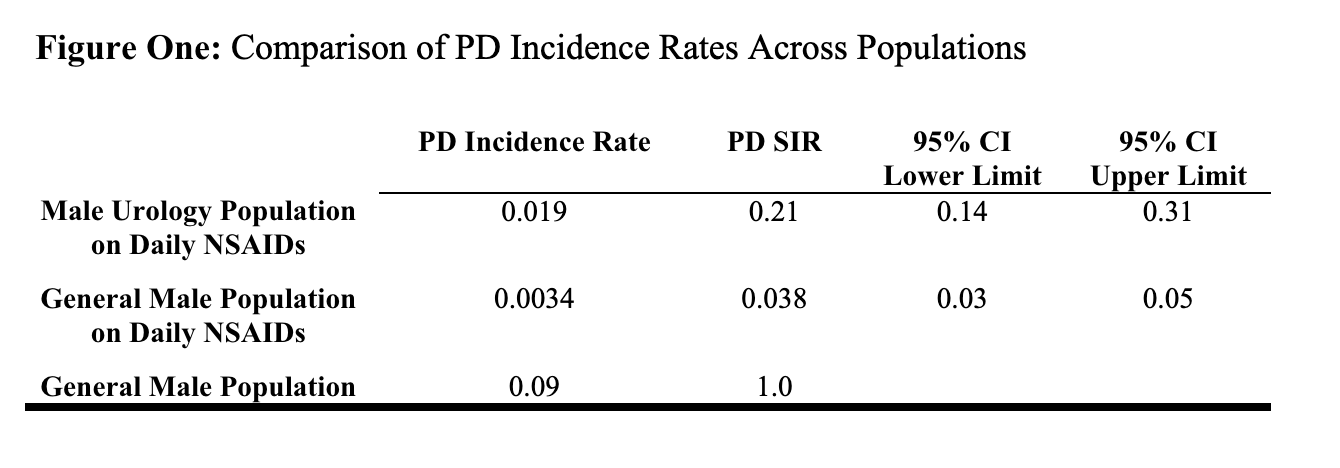
Introduction: Peyronie’s disease (PD) can be a devastating condition in affected men, causing inflammatory fibrotic tissue to form a plaque within the tunica albuginea of the penis. Although the etiology of PD is not completely understood, it is known that it is related to an escalated inflammation of penile tissue. It is estimated that PD affects around 1 in 11 men, or about 9% of the general male population. Knowing the general pathophysiology of the PD process, the objective of this study is to investigate whether men who take moderate to high levels of anti-inflammatory medications (NSAIDs) for any condition experience PD at the same rate as the general American male population. Methods: We identified male patients from a single medical facility, who have been prescribed indomethacin, celecoxib, naproxen, or etodolac daily; the patients were further stratified into a urology-specific cohort and a non-urology, general medicine population. Using these criteria, we included over 15,000 patients from 3/1/2015 - 9/1/2022, and subsequently identified which of these patients had been diagnosed with PD through a retrospective chart review. From these data, we calculated incidence rates, standard incidence ratios (SIR), and 95% confidence intervals (CI). Results: Statistical analysis revealed that male urology patients taking daily NSAIDs developed PD at rate of 1.9%, while the general male population taking daily NSAIDs developed PD at rate of 0.34%. The SIR for the urology-specific cohort is 0.21 (CI: 0.14-0.31); the SIR for the general cohort is 0.038 (CI: 0.03-0.05). Neither 95% CI contains 1.0, indicating that the observed rates are both statistically significantly reduced. Conclusions: Our study has demonstrated that men taking daily NSAIDs may benefit from protective factors against PD due to its well-known anti-inflammatory basis. The incidence rate of PD in the general patient population may be artificially reduced in the study due to lack of careful penile assessment. It is presumed, however, that the incidence rate of PD in the urology-specific population taking daily anti-inflammatory medications has been accurately identified. These findings identify a protective role of NSAIDs and support the concept of inflammation as a crucial event in PD development. SOURCE OF Funding: None.