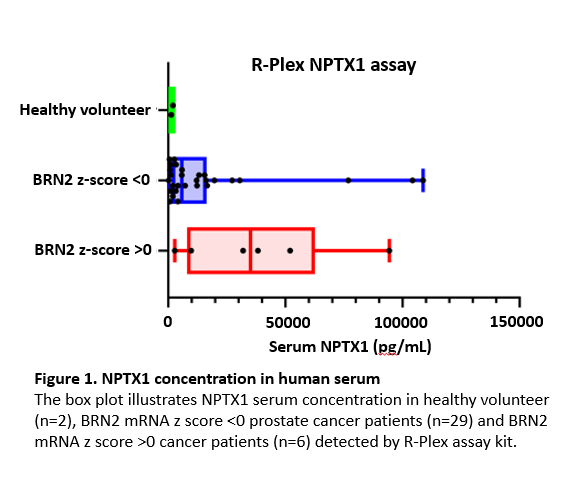
Introduction: Androgen receptor (AR) pathway inhibition is the first-line therapy for metastatic prostate cancer (PCa). However, tumors invariably develop resistance to ARPI. We previously identified a transcription factor Brain-2 (BRN2), encoded by the gene POU3F2, as a master driver of NEPC which is an aggressive form of AR-independent phenotypes treatment resistant PCa. In this study, we identified a surrogate biomarker of BRN2 activity to monitor the progression of treatment resistant PCa. Methods: To identify BRN2 serum marker, we analyzed BRN2 ChIPseq data from 2 NEPC and 2 neural-type lung squamous cell carcinoma (nLUSC) cell lines with a focus on shared BRN2 peaks. Annotated peaks from enhancers (EnhancerAtlas) and promoters (genes within 20kb) were selected for secreted proteins and were ranked by correlation with BRN2 expression in PCa patients. Validation of protein expression was performed by western blot. R-PLEX Assay kit was used to measure concentrations in culture media from NCI-H660 cells and in serum from mice with NCI-H660 xenograft or PDX tumors and from human PCa patients. Results: We identified 51 candidate serum biomarkers for BRN2 activity (or expression?) using the methods described above. These biomarkers were ranked based on their expression and correlation with BRN2 expression in PCa patient samples across four public data sets. NPTX1 was identified as the top biomarker of BRN2 expression. We further validated association of NPTX1 and BRN2 expression by BRN2 overexpression in MR42D and 22Rv1, indicating that BRN2 positively regulates NPTX1 expression. Next, we showed that NPTX1 is present in culture media from NCI-H660 cells, and that NPTX1 serum concentration positively correlated with tumor volume in mice with NCI-H660 xenografts and with NPTX1 mRNA expression in LuCaP PDX models. Importantly, evaluation of patients’ samples showed that NPTX1 levels were high in 26/35 CRPC serum samples vs levels in serum of healthy volunteers, and that the NPTX1 serum levels were highest in 4/6 patients with high POU3F2 tumor expression. Conclusions: We identified and validated NPTX1 as a serum marker that can be readily detected in serum from NEPC patients with BRN2high tumours. SOURCE OF Funding: U.S. Army Medical Research and Development Command (W81XWH1810689)