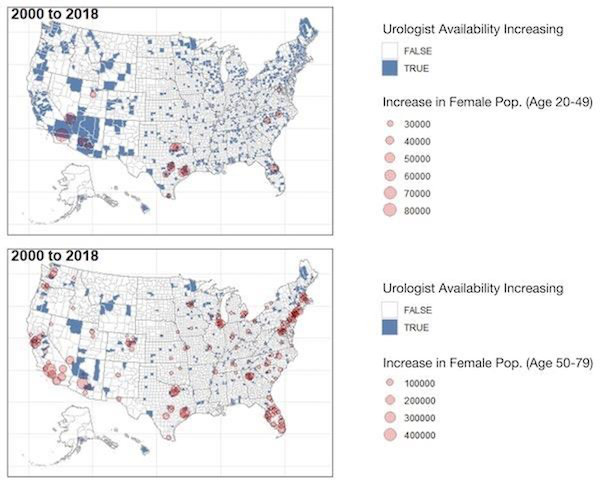
Introduction: Models have projected worsening urologist shortage in the coming decades. This has led to persistent concerns regarding patient access to urologic care. However, no studies have accounted for disparities in access to care between males and females, and more specifically disparities among females by age. Our study evaluated urologist availability by US county since 2000 to identify factors associated with access to urologic care. Methods: County level data from 2000, 2010, and 2018 from the HHS, U.S. Census, and ACS were analyzed. Availability of urologists by county was defined as urologists per 10,000 males and females aged 20-79. This was further stratified to compare females aged 20-49 and 50-79. Changes in population over time for rural and metropolitan counties were calculated. Multiple logistic geographically weighted regression models and ten-fold cross validation were performed. Results: Overall urologist availability worsened over 18 years by 13% (–0.03 urologists/10k individuals; 95% CI 0.02-0.04, p<0.0001), for both males (-0.09, p<0.00001) and females (-0.05, p=0.0006). Analysis of urologist availability in metropolitan versus rural counties revealed –29.5% and –9.4% change in access to care for males and –20.9% and +0.63% for females, respectively. Further analysis of females stratified by both county type and age identified that older females in rural counties experienced a more severe decline in access to urologists (-41%, -0.5 urologists/10k females). On multivariate analysis, metropolitan status was the greatest predictor of urologist availability for both males and females (OR 2.09, 95% CI 1.63-2.68 and OR 1.68, 95% CI 1.14-1.45, respectively). The weight of these factors varied by region. Conclusions: Urologist, male, and female populations increased in metropolitan areas however, availability of urologists worsened for both sexes overall. When stratified by age, there was an increase of older females both in metropolitan and rural counties, reflecting the aging female population. While older rural female populations increased at a slower rate, this subset of patients experienced the worst decline in urologist availability over 18 years. Factors influencing population shifts and their regional drivers need to be investigated to prevent worsening disparities in care. SOURCE OF Funding: N/A