Resident Physician Einstein Healthcare Network, Philadelphia, PA
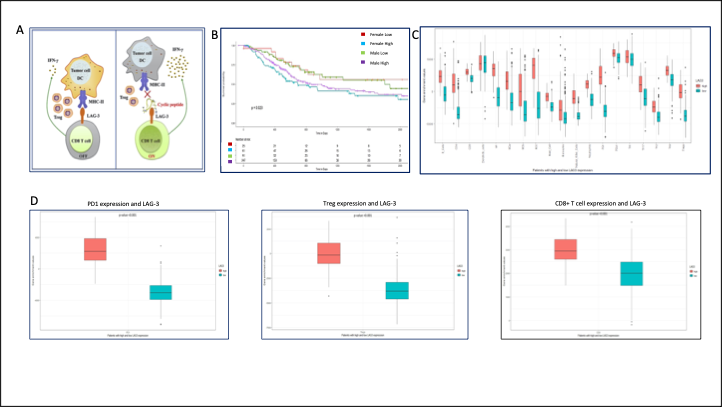
Introduction: Expression of lymphocyte activation gene-3 (LAG3), an immune cell transmembrane protein with a regulatory impact on tumor microenvironments, has been identified as a promising checkpoint for emerging immunotherapies. We sought to evaluate the impact of LAG3 expression on bladder cancer survival and the immune regulatory environment. (Fig 1A) Methods: RNA seq data for bladder cancer was obtained in TCGA from TCGA Data Portal (https://tcga-data.nci.nih.gov/docs/publications/tcga/). Wilcoxon rank-sum test was used for all pairwise comparisons. Spearman Rho was used for all correlations, and P-values were calculated using either the exact permutation distributions (for small sample sizes) or large-sample approximations. All P-values are from two-sided tests, and P < .05 was used as the threshold for statistical significance. The Kaplan-Meier method and log-rank test were used to evaluate overall survival and compare inter-group survival, respectively. Sub-analyses were performed to compare gene enrichment values (GEV) among various immunologic cell types and immune markers with known associations with oncologic outcomes. Results: We identified 424 patients with LAG3 expression and survival data in the TCGA BLCA cohort. Patients with low LAG3 expression had a statistically significant higher OS compared to patients with MIBC and lower expression (p=0.0006). When stratified by gender and age, receipt of chemotherapy, high LAG3 expression remainder significant prognostic factors for OS (p=0.023)(Figure 1B). As LAG-3 expression across immune cells, we compared LAG-3 expression across immune cell subtypes. High LAG-3 expression in muscle invasive bladder cancer (MIBC) decreased infiltration of CD8+/M2b macrophages/Th17/Tregs and B cells (p < 0.001). Likewise, comparison of high and low LAG-3 expression demonstrated increased Treg expression, increased CD8+ T cell with enhanced PD1 expression, reflecting marked immunoevasive environment with CD8+ T cell dysfunction. Conclusions: Our study reported LAG-3+ cells abundance was an independent predictor for poor OS in MIBC patients within TCGA cohort. Blockade with LAG-3 inhibitors in bladder cancer is critical to explore as potential novel adjunctive therapy. SOURCE OF Funding: NA