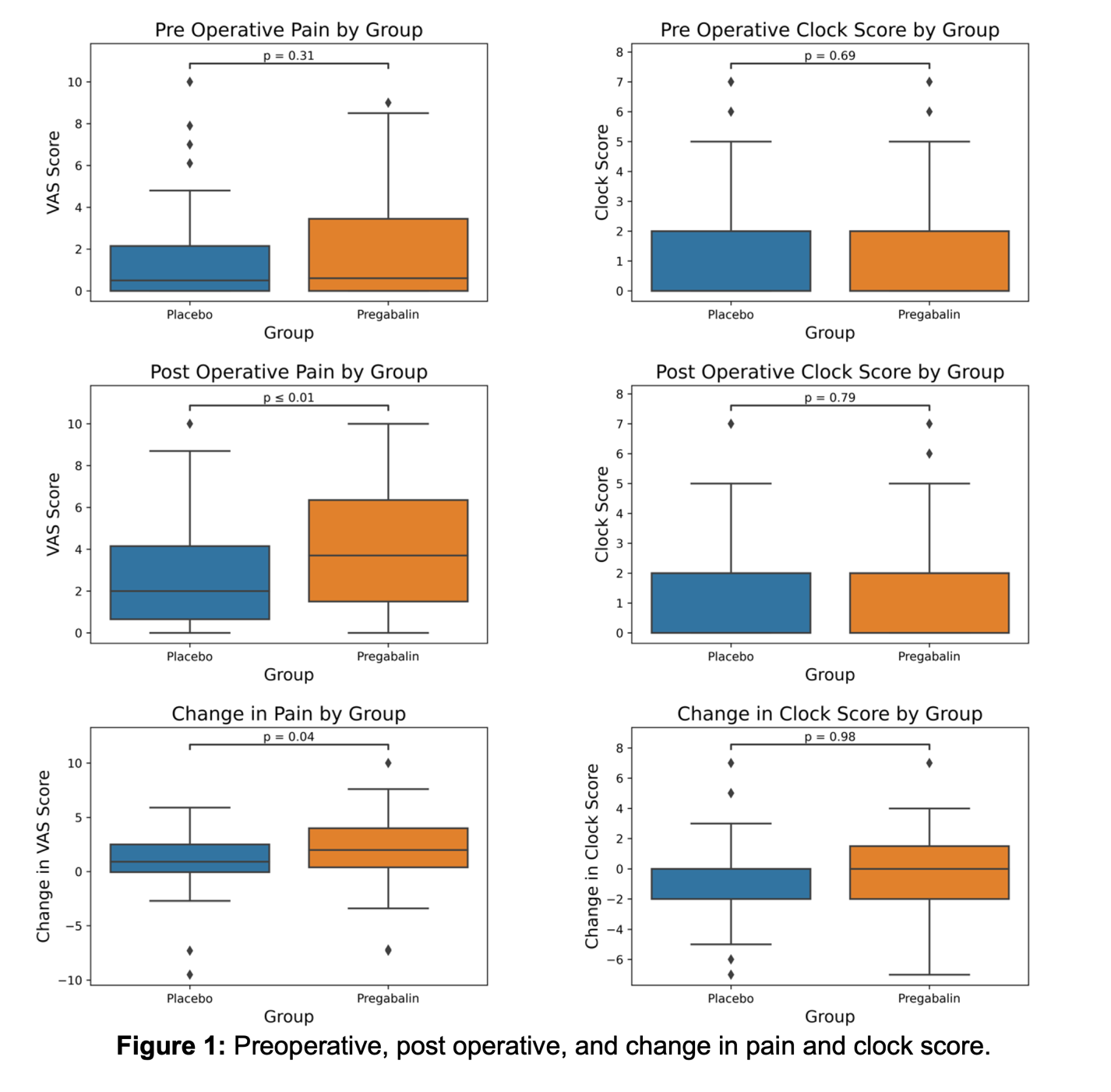
Introduction: Perioperative pregabalin is used as a part of many enhanced recovery after surgery programs. There is mixed evidence regarding its efficacy, with decreased pain, anxiety, and nausea in some settings, and no impact in others. Here, we tested the safety and efficacy of single-dose perioperative pregabalin in our patients undergoing elective ureteroscopy. Methods: This double-blind trial was IRB approved and registered (MU#2017676, NCT03927781). We randomized patients undergoing ureteroscopy to receive 300mg pregabalin or placebo one hour before surgery. Patients were excluded if they did not have normal renal or cognitive function. They could not have prior history of complex urological conditions and could not be on chronic narcotics. We had patients perform a visual analog pain scale and a Watson clock drawing before medication administration and approximately one hour after surgery. Results: One-hundred eighteen patients were enrolled, randomized, and received medication. The groups differed in median age (control 57 vs 44 years study, p=0.009) with no difference in other baseline characteristics. Preoperative pain scores were similar in both groups (0.5 vs 0.6, for control and study, respectively, Figure 1). Patient reported post operative pain scores were worse in the study group (2 vs 3.7, P=0.004) as was the change in score per individual (0.9 vs 2, P=0.04). On multivariable analysis including age, gender, and study group there was no statistically significant effect of the medication (P=0.1). Change in Watson clock scores were not different based on medication (-0.05 vs -0.15, P=0.98, placebo and pregabalin, respectively), even after accounting for gender and age. Conclusions: In this single center double-blind randomized controlled trial, we demonstrate that pregabalin does not decrease pain after ureteroscopy when compared to placebo. We also show that there was no negative impact of high dose pregabalin on cognition after the procedure. There is a need to find better adjunctive treatments for pain related to ureteroscopy, but our results suggest that, while safe, single dose perioperative pregabalin may not be efficacious in this setting. SOURCE OF Funding: University of Missouri Research Council Grant