Session: MP12: Diversity, Equity & Inclusion: Health Equity & Outcomes I
MP12-16: Disparities remain in knowledge of penile cancer and human papilloma virus among racial minorities after accounting for regular provider visits and socioeconomic factors
University of Pennsylvania, Perelman School of Medicine
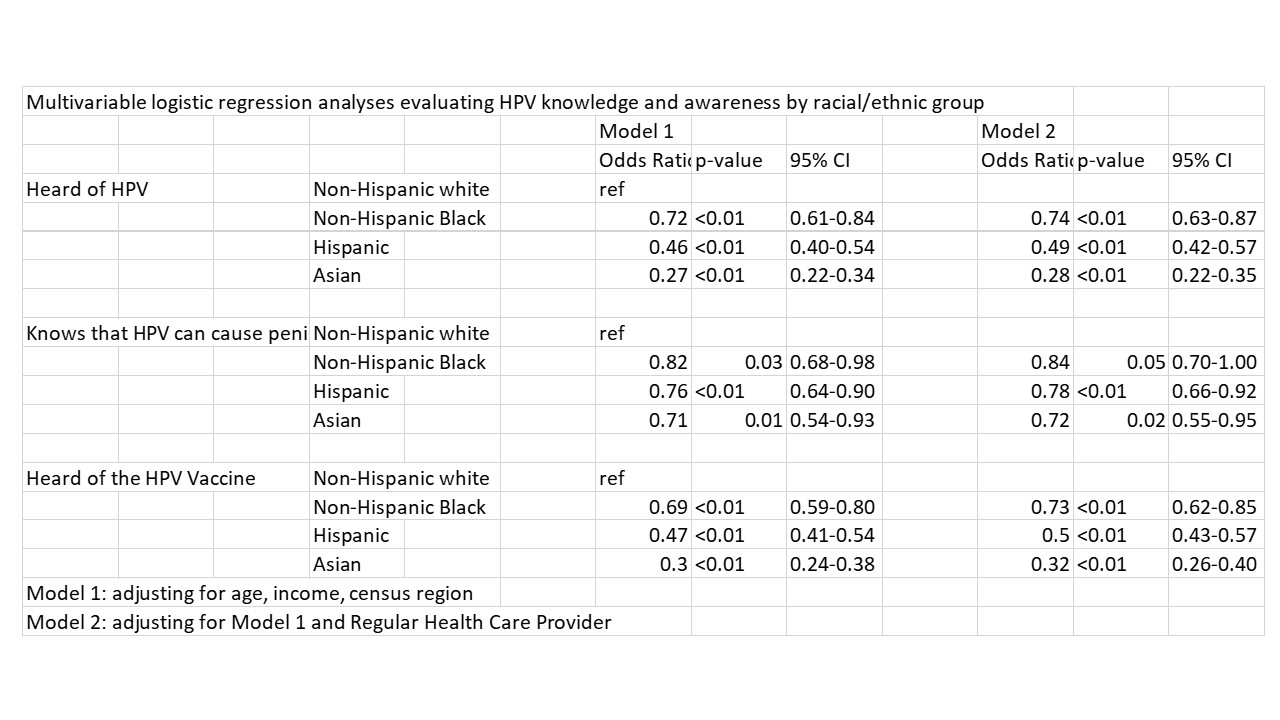
Introduction: Non-Hispanic Blacks (NHB) and Hispanics are disproportionately impacted by HPV and HPV-associated cancers, but are much less likely to receive an HPV vaccination compared to Non-Hispanic Whites (NHW). It is essential to understand racial and ethnic differences in the awareness of HPV and the HPV vaccine in order to address these disparities. Methods: The National Cancer Institute’s Health Information National Trends Survey (HINTS) 5 is a nationally representative survey of United States adults. Multivariable logistic regression models were used to examine HPV knowledge within each racial/ethnic group after adjusting for sociodemographic characteristics. A second fully adjusted model was used to determine if health care provider status had an impact on the association between race and HPV knowledge. Results: Of the 8,792 total respondents, 1,158 (14.3%) were NHB, 1,326 (16%) were Hispanic, and 431 (5.3%) were Asian. Only 20.1% of respondents were aware that HPV could cause penile cancer. 37% of NHB, 42% of Hispanics, and 51% of Asians did not know what HPV was, as compared to 29% of NHWs (p < 0.01). Those who had no knowledge of HPV were less likely to have regular providers, trust information from doctors, and reported difficulty finding health information (p < 0.01). After adjusting for sociodemographic factors, all minority groups had significantly lower odds compared to NHWs of correctly identifying all HPV knowledge statements (p < 0.01). Having a regular healthcare provider did not attenuate the racial disparities in HPV knowledge or awareness of the vaccine in the adjusted model (p < 0.01). Moreover, adequate visit time, clear explanations, and increased shared decision making also did not impact the disparities in knowledge (p < 0.01). Conclusions: The racial disparities in penile cancer awareness and HPV knowledge remain immense. Asians and Hispanics reported the lowest rates of knowledge of a connection between HPV and penile cancer, and awareness of the HPV vaccine. Surprisingly, having a regular provider does not appear to attenuate these significant racial disparities. Future studies are required to understand the best methods to improve knowledge of the HPV vaccine and vaccination rates among minority populations. SOURCE OF Funding: none

.jpg "Hanna Jia, BA photo")