Session: PD07: Kidney Cancer: Localized: Surgical Therapy I
PD07-03: Unveil the interplay between baseline renal function, warm ischemia time and tumor complexity when assessing renal functional outcomes of on- vs off-clamp robot-assisted partial nephrectomy
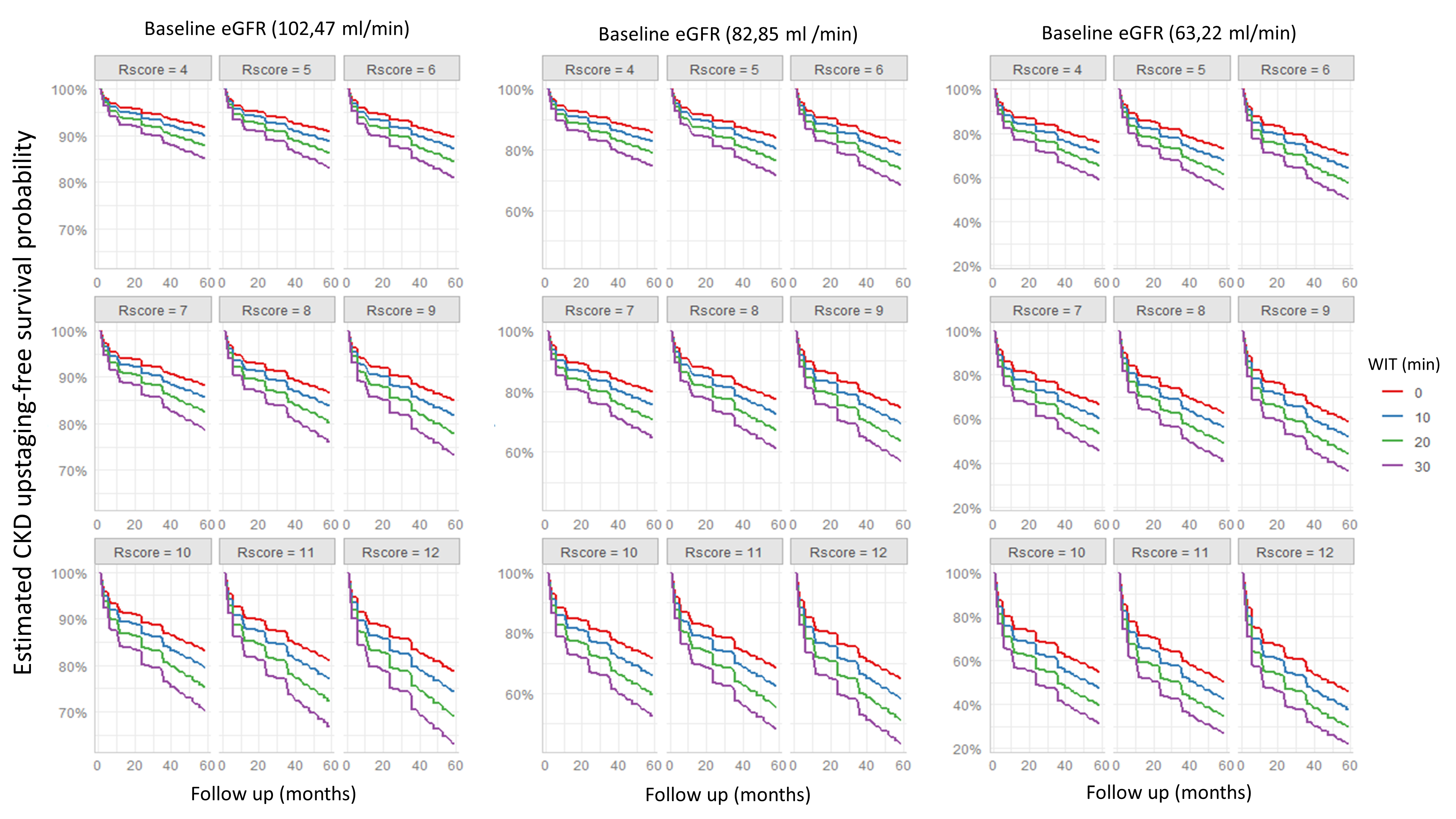
Introduction: Off-clamp robot-assisted partial nephrectomy (RAPN) has been introduced as an alternative to on-clamp RAPN aiming at maximally reduce warm ischemia time (WIT). However, not all studies agreed with the theoretical benefit of off- vs on-RAPN in term of postoperative and functional outcomes. It might be postulated that prolonged warm ischemia time (WIT), needed when approaching complex renal masses, as well as baseline eGFR may influence the results of such a comparison. We aimed at showing the interplay bewteen WIT, tumor complexity and baseline eGFR. Methods: Whitin a multinstituional databases we identified patietns treated with RAPN for kidney neoplasm (cT1-2, cN0, cM0). Exclusion criteria were multiple renal masses, solitary kidney, selective clamping. LOESS curve depicted the association between WIT and RENAL score. Multivariable Cox regression model addressing any upstaging to CKD = 3a (CKD-upstaging) tested the effect of WIT, baseline eGFR and RENAL score while adjusting for important confounders (age, sex, BMI, ASA, hypertension and diabetes). The “ggeffect” R package allowed to estimate the CKD-upstaging free survival probability according to WIT, RENAL score and baseline eGFR. Results: Overall, 1015 patients were identified between on- vs off-RAPN (37 vs 63%, respectively). LOESS curve showed a statistically significant increase in WIT, when approaching more complex renal masses (p < 0.001). Interestingly, for RENAL score = 10, off-RAPN required a median WIT = 25 minutes. In multivariable Cox regression model, WIT (HR 1.02, 95%CI 1.01-1.03, p<0.001), baseline eGFR (HR 0.97, 95%CI 0.96-0.98, p<0.001) and RENAL score (HR 1.14, 95%CI 1.07-1.21, p<0.001) were all independent predictors of CKD-upstaging. Estimated probability was graphically displayed (Figure). Conclusions: We observed that when approaching more complex RENAL masses on-clamp RAPN may results in prolonged WIT which in turn would drastically increase the risk of renal function decline especially in those patients harboring lower baseline eGFR. In this complex situation, off-RAPN would undoubtedly reduce risk of renal function deterioration by limiting to zero WIT which represents the main surgical modifiable factor. SOURCE OF Funding: no